
There is a strange gap in the small business world. Everyone agrees that trust is the foundation of growth. Ask any owner what makes their business work and you will hear some version of the same answer: people trust us. Our reputation. Our word of mouth. Our name in this town.
Then ask the follow-up question: what are you doing, deliberately and in order, to build that trust?
The room usually goes quiet. Not because the owner is lazy. Because nobody has ever handed them a map. Marketing advice tells them how to get attention. Sales advice tells them how to close. Branding advice tells them how to look. Almost nothing tells them how to become trusted — step by step, in a specific order, in the community where they actually operate.
The Trust Ladder is a twelve-rung framework for how a local business earns durable trust in its community. It is organized into five bands — Grounded, Connected, Proven, Generous, and Established — and each band contains the specific rungs a business must climb before the next band becomes possible. It is not a sales funnel. It is not a branding exercise. It is a sequence of behaviors, and like a real ladder, it only works in one direction at a time: up.
And, like a real ladder, you can slide down it. We will get to that
Direct answer
A small business builds community trust by climbing through five stages: getting grounded in what trust is, connecting with local networks and anchors, proving itself through visible signals and first referrals, giving before it asks, and becoming established through findability, measurement, and practices that outlast the owner.
The Edelman Trust Barometer has tracked this decline and its drivers for more than 25 years.
Trust in institutions has been falling for a generation. Government, media, corporations, even neighbors — the long-term trend lines all point the same direction. The reasons are well documented and not worth relitigating here. What matters for a local business owner is the flip side of the trend.
When trust in big institutions falls, it does not vanish. It localizes. People stop trusting the faceless chain and start trusting the person they can look in the eye. They stop trusting the national review platform they suspect is gamed and start trusting the neighbor who used the plumber last month. They stop trusting advertisements entirely and start trusting the coach, the pastor, the Rotary president, the office manager who seems to know everyone.
In other words: the collapse of institutional trust is the single greatest competitive opening a local business has had in fifty years. The businesses that understand this stop trying to look bigger and start trying to be more trusted. Those are not the same project, and confusing them is expensive.
But there is a catch. Local trust cannot be manufactured on a deadline. It cannot be bought with a bigger ad budget. It is earned through a sequence of behaviors that build on each other — and it evaporates the moment the sequence is faked. That is why a ladder, and not a campaign, is the right shape for this work.
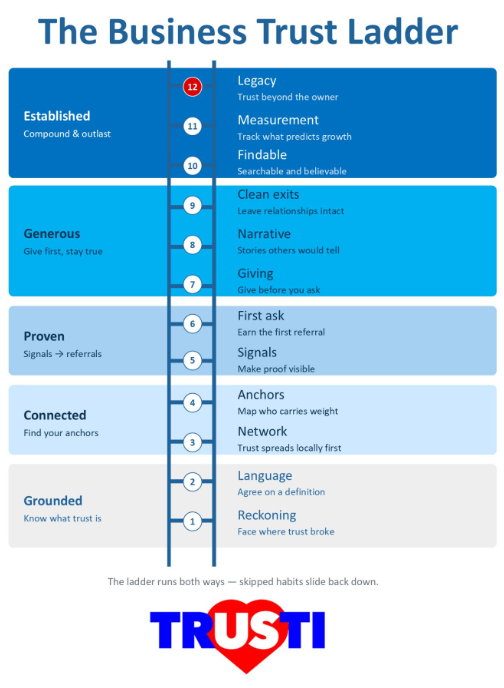
Picture a ladder leaning against a wall. At the ground is where every business starts: untrusted by default, simply because strangers are strangers.
At the top is where a very small number of businesses ever arrive: so trusted that their name is a local institution, their customers recruit for them, and their reputation survives the founder’s retirement.
Between those two points are twelve rungs, grouped into five bands:
Grounded — Rungs 1 and 2: Reckoning and Language. Before anything else, a business must face where it stands and agree on what trust even is.
Connected — Rungs 3 and 4: Network and Anchors. Trust travels through relationships, so the business must plug into the community’s real networks and find the people whose word carries weight.
Proven — Rungs 5 and 6: Signals and First ask. Trust becomes visible. Strangers can see proof, and the business earns its first genuine referrals.
Generous — Rungs 7, 8, and 9: Giving, Narrative, and Clean exits. The business gives before it asks, earns stories other people tell, and handles endings with integrity.
Established — Rungs 10, 11, and 12: Findable, Measurement, and Legacy. Trust is verified online, measured so it can compound, and built to outlast the owner.
Each band rests on the one below it. You cannot earn referrals (Proven) from networks you never joined (Connected). You cannot be found online in a credible way (Established) if your reputation has cracks you never faced (Grounded). The order is not a suggestion. It is the physics of how trust accumulates between people.
Here is each band, and the rungs inside it.
Every trust problem in a business eventually shows up in public. But almost every one of them starts in private, inside the owner, long before a customer notices. The Grounded band is where a business faces that honestly and builds the shared language to do something about it.
Trust rarely breaks in one dramatic scandal. It erodes. A callback that never happened. An estimate that quietly grew. A complaint that got a defensive answer instead of a real one. None of these feels like a crisis, which is exactly why they are dangerous: by the time the pattern shows up in reviews or in the silence of a phone that stopped ringing, it has been running for years.
The Reckoning rung is the discipline of facing where trust actually stands — not where the owner hopes it stands. It means asking uncomfortable questions: Where have we overpromised? Which customer left quietly and why? What do people say about us when we are not in the room, and how do we know?
A business that skips this rung builds everything else on a foundation it has never inspected.
You cannot build what you cannot define. Ask ten employees what “trust” means to a customer and you will get ten answers, most of them vague — honesty, quality, being nice. All true, none useful. Vague values produce vague behavior.
The Language rung gives the business a working definition: trust is the customer’s willingness to accept vulnerability based on positive expectations of your behavior. From there it breaks into dimensions a team can actually work on — competence, honesty, reliability, benevolence, and predictability.
Once a business has shared language, “build trust” stops being a poster on the wall and becomes a set of observable behaviors that can be practiced, taught, and corrected.
Trust does not travel through advertising. It travels through relationships — and every community already has a living web of them. The Connected band is about plugging into that web instead of shouting at it from outside.
One endorsement inside a trusted local network outperforms a thousand impressions to strangers, and it is not close. The reason is what sociologists call social capital: communities run on accumulated relationships, norms, and mutual obligation. When a business is vouched for inside that web, it borrows credibility it could never buy. When it markets from outside the web, every stranger starts at zero.
The Network rung is the deliberate work of showing up in the community’s real networks — the service clubs, the school events, the trade groups, the informal circles where people actually talk — and showing up as a participant, not a vendor.
This is slower than buying ads. It is also the only channel that compounds.
Every community has a small number of people whose recommendations move everyone else. They are not influencers in the social media sense. They are the office manager who fields every “who should I call?” question, the contractor every homeowner trusts, the coach, the principal, the longtime volunteer whose judgment nobody questions. Sociologists call them opinion leaders. Locals just call them “the person to ask.”
The Anchors rung is the work of identifying these people systematically — most towns have far more than owners realize, sorted into recognizable types — and earning a place on their mental referral list. Not by pitching them.
By being the kind of business they would stake their own reputation on, because that is exactly what an anchor does every time they recommend someone.
Everything up to this point has been building trust in private and in relationship. The Proven band is where trust becomes visible to strangers — and where the business starts receiving the clearest proof trust can produce: people sending other people.
Trust that nobody can see does not compound. A stranger deciding whether to call you cannot watch your twenty years of honest work. They can only see its residue: your reviews, your testimonials, the recognitions and memberships and ratings that stand in for the reputation they cannot personally verify.
The Signals rung treats this residue as an asset to be built deliberately — asking for reviews systematically and at the right moments, responding to them like a professional, collecting real customer stories, and displaying recognition where strangers will actually encounter it.
It also comes with a hard legal and ethical line: reviews and endorsements must be genuine. Buying them, faking them, or hiding incentives is not just risky, it is deceptive advertising, and regulators treat it that way. Fake signals are how businesses slide down the ladder, not up it.
Nothing proves trust like a referral. A person who recommends your business is staking a piece of their own reputation on you — which is why the first ask terrifies most owners, and why almost nobody has a system for it. They wait for referrals to happen and call it word of mouth, the way you might wait for rain and call it farming.
The First Ask rung replaces waiting with a practice: understanding the moments when a happy customer genuinely wants to refer you, learning to ask in a way that feels like an invitation rather than pressure, and making the act of referring effortless.
The goal of this rung is modest and transformative — the first earned referral, then the second, then a habit.
The widest band on the ladder, and the one where most businesses stall. Generosity is where trust stops being a transaction and becomes a reputation. It is also where fakery is most visible, because a community can smell strategic generosity from a mile away.
Reciprocity is one of the deepest norms in human behavior: people feel genuinely obligated to return what is given to them. Every good salesperson knows this, which is precisely the danger. Giving that is calculated to trigger reciprocity is not generosity — it is bait, and communities can tell the difference, even if they cannot articulate it.
The Giving rung is the practice of contributing to the community with no mechanism for return: the advice given freely, the introduction made with nothing attached, the event sponsored because it matters to the town. Paradoxically, this no-strings giving is what produces the deepest loyalty. But it only works when the strings are actually absent.
That is why it sits this high on the ladder — you cannot fake your way up to it, and you cannot sustain it if the lower rungs are hollow.
The stories that determine a business’s future are not the ones the business tells. They are the ones the community tells about the business — at kitchen tables, in bleachers, in the parking lot after the meeting. Marketing copy is a claim. A retold story is evidence.
The Narrative rung applies a simple test to every story a business generates: the Third-Person Test. Would someone else tell this story, accurately and willingly, without you in the room? Stories that pass — the furnace fixed on Christmas Eve, the deposit returned when it didn’t have to be — become the business’s real reputation, replicated by people with no stake in telling them.
This rung is about finding those stories, earning more of them, and telling customers’ stories in ways that honor rather than exploit them.
Here is a rung almost no business framework mentions: how you end things. Every business faces exits — the customer who must be let go, the partnership that has run its course, the employee moving on, eventually the sale or closing of the business itself. Most owners handle these badly, through avoidance or blame, and each bad exit plants a storyteller in the community with a grievance and an audience.
Communities remember exits longer than sales. The Clean exits rung is the discipline of ending relationships with honesty and dignity: resolving every obligation, communicating early and directly, and leaving the other party able to speak well of you — or at least without a true story to tell against you.
It is the least glamorous rung on the ladder and one of the highest-leverage.
The final band is where earned trust becomes durable. A business that reaches it is no longer just liked. It is findable, measurable, and built to last beyond the person who built it.
Trust today is earned in person and verified online. Before anyone calls you, they check: your reviews, your profile, your website, your consistency. This verification reflex is automatic, and it happens to every referral you earn. A warm recommendation followed by a thin or contradictory online presence quietly dies. The same recommendation followed by a strong digital doorstep converts.
The Findable rung treats the business’s online presence as the modern front step: a complete and accurate local search profile, consistent information everywhere the business appears, and a review profile strong enough to confirm what the referrer just said.
Offline trust brings people to the door. This rung makes sure the door looks like the reputation.
Trust feels unmeasurable, which is why most businesses never manage it. But trust produces behavior, and behavior is countable. How many customers refer? How many return? How fast do reviews accumulate, and how quickly are problems resolved? These proxies do not capture everything trust is, but they capture whether it is growing — and what gets measured gets compounded.
The Measurement rung installs a simple monthly ritual: a handful of trust proxies, a baseline, and an honest look at the trend. The point is not dashboards. The point is that a business tracking trust notices erosion in weeks instead of years — the difference between a repairable crack and a Reckoning it never saw coming.
The top rung answers the hardest question: does this business’s trust belong to the business, or to the owner? For most local businesses, the honest answer is the owner — which means the trust retires when they do, and the business they spent decades building is worth a fraction of what it could be.
The Legacy rung is the work of transferring trust from person to institution: documented practices so the experience survives staffing changes, a team trained and trusted to carry the reputation, and succession thinking that starts years before anyone is leaving.
A business on this rung is not just trusted. It is durable — sellable, transferable, and able to keep serving its community for another generation.
Every framework in the marketing world climbs in one direction: up, toward the sale. The Trust Ladder is different in a way that matters. You can slide down it.
Skip the Giving rung and start asking early, and the Proven rung’s referrals dry up. Fake a story or buy reviews, and the Signals rung collapses — along with everything above it, because a community that catches you faking proof questions everything else it believed about you. Botch a single exit badly enough, and the Anchors who carried your name quietly stop carrying it.
This is not a flaw in the model. It is the model working. Real trust is conditional — it persists exactly as long as the behavior that earned it. A ladder you can slide down is simply an honest picture of that. It is also a diagnostic tool: when growth stalls, the question is not “how do we market harder?” It is “which rung did we skip, or which one did we slide off?” The answer is almost always lower on the ladder than the owner expects.
Because the word “ladder” gets borrowed by every kind of business framework, it is worth drawing three clear boundaries around this one.
It is not a sales funnel. Funnels move a customer from stranger to buyer, and every stage exists to serve the transaction. The Trust Ladder moves a business from unknown to institution, and most of its rungs — giving, storytelling, clean exits — produce no transaction at all. Funnels are about extracting a decision from a person. The ladder is about becoming the kind of business a community decides on its own to keep.
It is not a personal branding exercise. Personal branding polishes the founder’s image. The ladder builds the business’s standing, and its top rung — Legacy — explicitly exists to make trust independent of the founder’s image. A personal brand can ride along with the climb, but it is cargo, not the vehicle.
It is not a campaign. Campaigns have start dates and end dates and are judged on spikes. The ladder is a standing operating condition, judged on trend lines. A business does not “run” the Trust Ladder the way it runs a promotion; it lives on it, the way it lives on its reputation — because that is what the ladder is: the reputation, organized so it can be worked on deliberately.
These distinctions matter practically, because they prevent the most common misuse: treating the ladder as a marketing initiative with a quarter’s budget and a KPI. Budgets and KPIs belong to rungs 5, 6, 10, and 11, where activity is visible and countable. The other eight rungs are behavior, and behavior is managed with standards, not spend.
For an owner who wants a concrete starting rhythm, the ladder condenses into a ninety-day sequence. This is not the full climb — it is the installation of the climbing habit.
Days 1–14: Ground yourself. Run the Reckoning audit from Rung 1 — the five uncomfortable questions, answered in writing, scored plainly. Then complete the five-dimension diagnostic from Rung 2 and name your weakest dimension. Do not fix anything yet. The goal of the first two weeks is an honest map, and honest maps take longer than owners expect because every instinct argues for skipping ahead to repair.
Days 15–45: Connect. From the mapping exercises in Rungs 3 and 4, choose one network and show up to it — with nothing to sell — at least twice. Write down your five most likely anchors. Make no approach to any of them. Simply begin being visible in the places where your community’s trust already flows. Six weeks of pure presence feels unproductive. It is the most productive thing on this list, and the only version that works.
Days 46–75: Prove. Install the review-asking practice from Rung 5 — every job, the right moment, one easy link, professional responses to everything that comes in. Then make your first deliberate referral ask using the Rung 6 scripts, and log what happened. By day 75 the business should have a visibly fresher review profile and at least one earned referral that would not have happened by weather.
Days 76–90: Look back down. Run the first monthly trust review from Rung 11 with whatever baseline numbers you now have. Then read Rung 9’s exit protocol and apply it to whatever relationship is currently drifting in your business — there is always one. Finish the ninety days by giving one no-strings thing, per Rung 7, that nobody will ever hear about.
Ninety days does not put a business at the top of the ladder. It puts the business on the ladder — with a map, a foothold, early proof, and the measurement habit that keeps the climb honest from then on.
The Trust Ladder is to be climbed, not admired. Three suggestions to put it to work:
1. Find your rung first. Read the twelve cluster articles in this series with one question in mind: where are we, honestly? Most businesses overestimate by a band or more. The Reckoning questions in Rung 1 are the best starting point even for businesses that feel established.
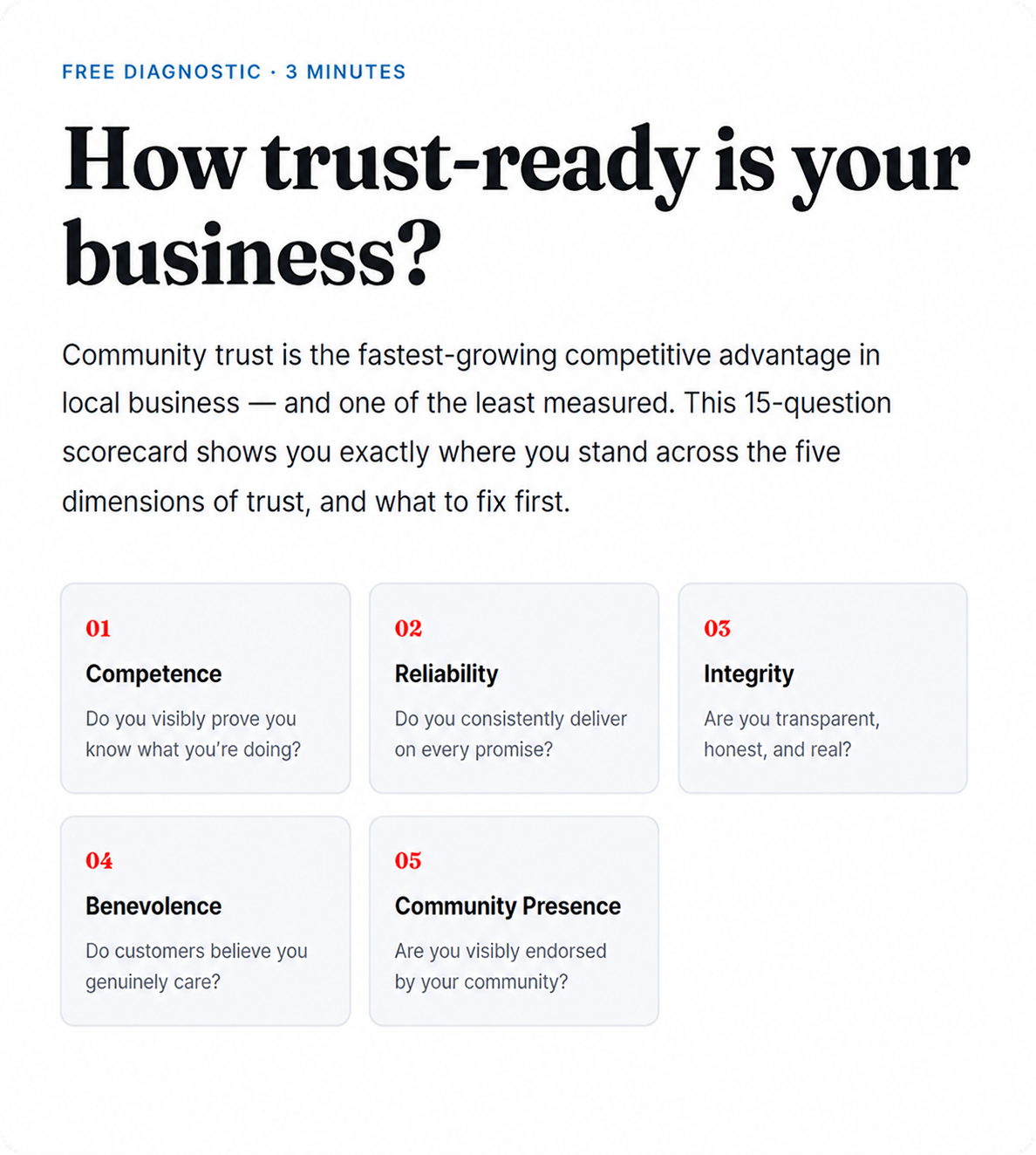
Your prospects and customers evaluate your business on five key dimensions:
Quite often, they reach their conclusion on your trustworthiness in a single moment of truth.
How do you improve your trustworthiness?
It starts with assessing how well you are doing today … and then developing a plan for continuous improvement.
2. Climb in order. Every rung below your current position is a crack in the foundation. Resist the pull of the upper bands — a business that jumps to Findable before Proven is polishing a doorstep in front of an empty house.
3. Treat the ladder as a standing practice, not a campaign. Trust erodes quietly, which means the lower rungs need periodic revisiting no matter how high you climb. The businesses that stay Established are the ones that never stop being a little bit Grounded.
Over the next twelve articles in this series, we will take each rung in turn — what it is, why it sits where it does, and the one practice that installs it. Start wherever the ladder says you are.
The towns and neighborhoods where your business lives are full of people looking for someone to trust. That search is the opportunity. The ladder is the way up.
Discover fresh perspectives on business and innovation

Get the latest strategies, tips, and expert advice delivered directly to your inbox.
By signing up, you agree to our Terms and Conditions.
Join your community and make the world a more trusted place—one review at a time.

Trusti Chief Marketing Officer
Bill Merrow is the Chief Marketing Officer at Trusti, where he writes about how local businesses grow through trusted community recommendations instead of anonymous reviews and paid ads.
A fractional CMO for more than 100 firms worldwide, Bill has led marketing and sales transformations at Cigna Healthcare, American Express, and General Electric — including building a 40,000+ person sales force and an annuity launch that drove $500 million in sales in 18 months.
His work centers on community-led growth, answer engine and SEO visibility, direct-response copywriting, and the referral, recognition, and lifecycle systems that turn happy customers into a business’s most effective sales force.
Bill believes the shortest path to a new customer is still a neighbor’s recommendation — and that marketing’s job is to make that endorsement easier to earn, easier to share, and impossible to ignore.


© 2026 Trusti | All rights reserved