



Ask ten people on your team what customers mean when they say “I trust that company” and you will get ten answers. Honesty. Quality. Good service. Being reliable. Being nice. All of these are true, and none of them are usable, because a word that means everything is a word you cannot manage.

This is a bigger problem than it sounds. Businesses routinely declare trust as a core value, print it on the wall, and then discover that nobody — not the owner, not the crew, not the newest hire — can say precisely what behavior would build it on a Tuesday afternoon. Vague values produce vague behavior. Vague behavior produces inconsistent customer experience. And inconsistent experience is, as we saw on the Reckoning rung, exactly what erodes trust.

Rung 2 exists to fix that. Before your business can build trust, it needs a shared, operational definition of what trust is — one that every employee can recognize, practice, and be corrected against. That is the Language rung.

Can national chains or out-of-market franchises ever truly compete with a local business that has both genuine community roots and a strong base of verified, transaction-backed reviews?

No — and that gap is structural, not temporary. National competitors can purchase advertising and inflate review counts, but they cannot fabricate the authentic local presence that comes from real staff, real addresses, real community involvement, and real customer transactions. When a business pairs genuine proximity signals with verified reviews tied to actual purchases, it creates a trust position that money alone cannot manufacture or replicate.

Direct answer

Why is business trust?

In social science, trust is the willingness to accept vulnerability based on positive expectations of another party’s behavior. For a business, that means customers accept risk — their money, time, or safety — because they expect the business to act in their interest, not merely its own.

Trust is the belief that another person will do what is expected and is built through repeated consistency.

Why “trust” needs a definition before a strategy

Most business languages are inherited, not designed. Owners pick up words like quality, service, and integrity from the culture around them and use them loosely, the same way the culture does. The trouble is that loose words cannot be delegated. You cannot tell a new technician “make sure customers trust us” the way you can tell them “always confirm the next-day callback before leaving the driveway.”

Trust research has spent decades on this problem, and its findings are more practical than most owners expect. Researchers studying organizations found that trust is not one thing — it decomposes into distinct, observable dimensions. A customer can believe you are skilled and still not trust you. They can believe you are honest and still not trust you. Trust only forms when several different judgments land in the right place at the same time.

That insight is the whole foundation of this rung: if trust has parts, you can work on the parts. And work on parts is management, which is something your business already knows how to do.

The working definition: vulnerability + positive expectation

Here is the definition to put in writing and teach to your team:

Trust is a person’s willingness to accept vulnerability
based on positive expectations of your behavior.

Read it slowly, because both halves matter.

Vulnerability is the recognition that the customer is taking a risk. When someone hires a plumber, they are risking their money, their time, their house, and — if the plumber is careless — their safety.

Trust is never free for the person giving it. Every transaction your business enjoys began with a customer agreeing to be vulnerable to you. Businesses that internalize this stop treating “the customer called us” as a marketing metric and start treating it as the transfer of a risk someone chose to carry.

Positive expectation is the mechanism that makes that choice possible. The customer handed you their vulnerability because they expected good things from your behavior.

Where do those expectations come from? From everything they have observed: your reviews, your estimator’s manner, your truck in the driveway, the neighbor’s story, the way your office answers the phone. Expectation is built from evidence — which connects this rung to every other rung on the ladder. Signals, referrals, stories, and reputation are all just evidence that feeds expectation.

When either half of the definition weakens, trust weakens. Reduce the customer’s perceived vulnerability (through guarantees, transparency, insurance) and trust gets easier. Raise their positive expectations (through proof, consistency, care) and trust gets deeper. Most trust-building work is one or the other.

The five dimensions customers silently score

In practice, customers evaluate a business on five dimensions, mostly without knowing they are doing it. Name them for your team and watch them start appearing in every customer conversation.

  • Competence — can you actually do the job? This is the dimension owners over-focus on, because it is what they were trained in. It is necessary and it is not sufficient. Plenty of technically excellent businesses are distrusted, because the other four dimensions failed.
  • Honesty — do you say what is true? Not just “do you lie,” but the subtler version: do you tell customers what they need to hear when it costs you something? The estimate that includes the unpleasant part. The “you don’t need that repair” that forfeits a sale.

  • Reliability — do you do what you said, when you said it? Reliability is honesty stretched across time. One kept promise proves nothing. Twenty kept promises build the expectation that promise twenty-one will be kept — and that expectation is reliability as the customer experiences it.

  • Benevolence — are you on my side? The customer wants evidence that you will act in their interest when your interests diverge. The moment a homeowner believes the contractor is optimizing for the contractor, no amount of competence rescues the relationship. Benevolence is demonstrated most powerfully in restraint: the repair not sold, the cheaper option recommended.

  • Predictability — will it be the same next time? The quietest dimension and, for repeat business, the most valuable. Customers return not to the best experience they have ever had but to the experience they can count on. A good business that is sometimes great and sometimes sloppy is trusted less than a good business that is always good.

Here is the practical power of the decomposition: when trust weakens, it is almost always one specific dimension, not “trust” in general. A pattern of late arrivals is a reliability problem. Pushy upselling is a benevolence problem. An inconsistent crew is a predictability problem. Naming the dimension turns “we need more trust” into “we need callbacks confirmed before end of day” — a thing a team can actually do on Tuesday.

Language audit: how your team talks about trust

With the definition and five dimensions in hand, audit the language your business already uses. Listen to how your team describes customers, jobs, and problems for one week.

You are listening for two things.

First, whether your people share the vocabulary — does “take care of the customer” mean the same visible behaviors to everyone, or five different private interpretations?

Second, whether the language blames or owns. “The customer is impossible” is a team that has defined trust as the customer’s job. “We set an expectation we didn’t meet” is a team that has defined it as theirs.

The definition in the room becomes the behavior in the field, every time.

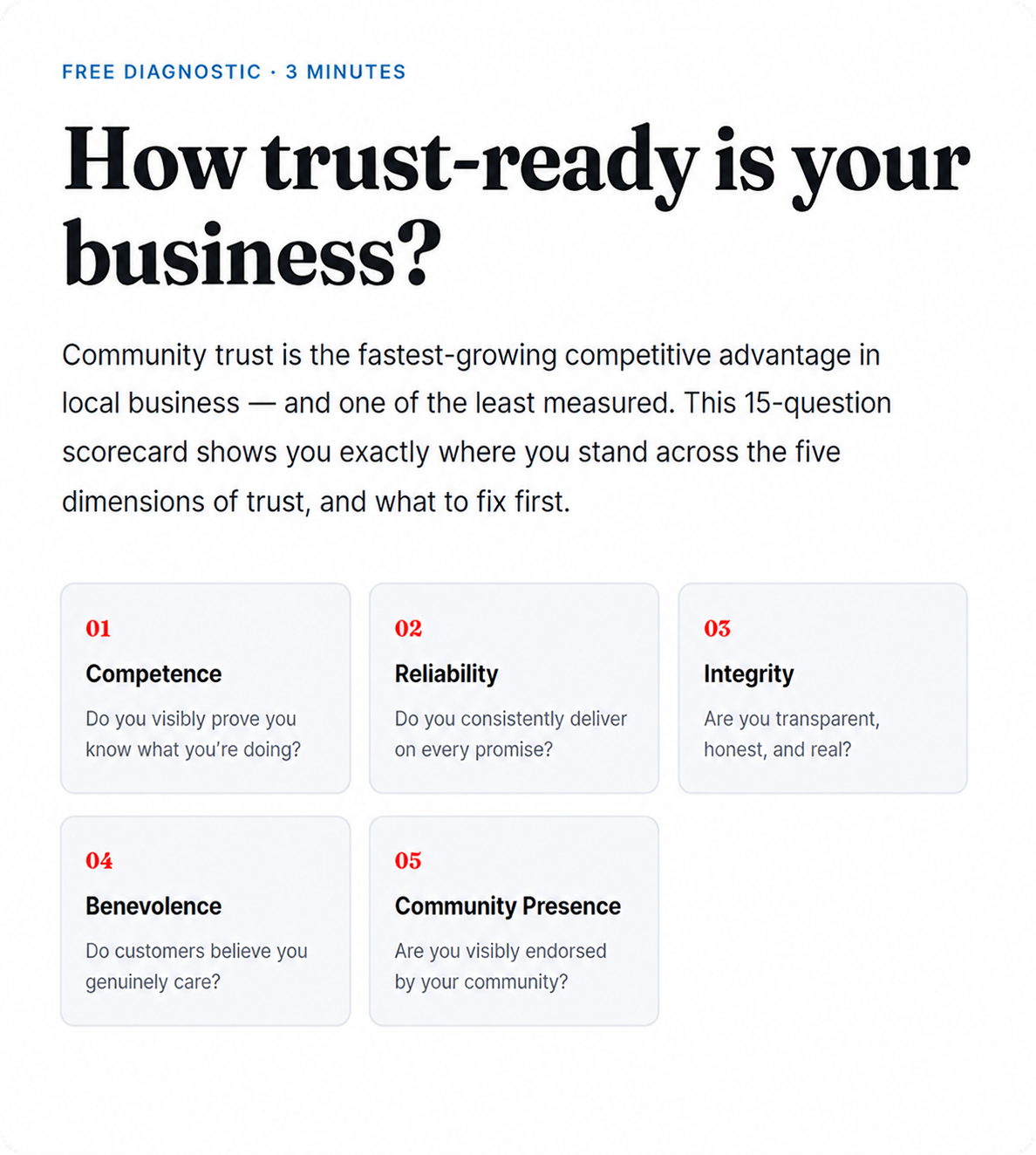
Is Your Business Earning Trust in Your Community?

Your prospects and  customers evaluate your business on five key dimensions:

  • Competence
  • Benevolence
  • Reliability
  • Community Presence
  • Integrity

Quite often, they reach their conclusion on your trustworthiness in a single moment of truth.

How do you improve your trustworthiness?

It starts with assessing how well you are doing today … and then developing a plan for continuous improvement.

how trusti-ready is your business

See where you stand today and start building your competitive advantage on TRUST.

One thing this week

Run the five-dimension self-diagnostic. For each dimension — competence, honesty, reliability, benevolence, predictability — write one sentence about where your business stands, backed by evidence rather than intention. Then circle the weakest one.

Your weakest dimension is your trust leak. Everything your business pours into marketing drains out through it until it is fixed.

Next rung: Network — grounded in what trust is, you are ready to plug into the relationships where it actually travels.

The takeaway: Trust is not a feeling you market toward. It is a customer’s willingness to carry risk because your behavior earned their expectation — and it decomposes into five dimensions your team can define, practice, and improve.

Return to The Trust Ladder Guide.

Never Miss a Business Insight

Get the latest strategies, tips, and expert advice delivered directly to your inbox.

By signing up, you agree to our Terms and Conditions.

Ready to join Trusti?

Join your community and make the world a more trusted place—one review at a time.

author avatar
Bill Merrow
Trusti Chief Marketing Officer Bill Merrow is the Chief Marketing Officer at Trusti, where he writes about how local businesses grow through trusted community recommendations instead of anonymous reviews and paid ads. A fractional CMO for more than 100 firms worldwide, Bill has led marketing and sales transformations at Cigna Healthcare, American Express, and General Electric — including building a 40,000+ person sales force and an annuity launch that drove $500 million in sales in 18 months. His work centers on community-led growth, answer engine and SEO visibility, direct-response copywriting, and the referral, recognition, and lifecycle systems that turn happy customers into a business's most effective sales force. Bill believes the shortest path to a new customer is still a neighbor's recommendation — and that marketing's job is to make that endorsement easier to earn, easier to share, and impossible to ignore.