



A heating contractor I know — call him Dave — ran a good company for fourteen years. Solid work, fair prices, a name people recognized around town. Then, over about eighteen months, his phone went quiet. Not silent. Just quieter, the way a stream runs lower so gradually you don’t notice until the rocks show.
Dave’s first instinct was marketing. He bought ads. He posted more on Facebook. He redid his truck wraps. Nothing moved, because the problem wasn’t that people couldn’t find him. It was that the people who knew him best had quietly stopped recommending him.
The story of how that happened — and what Dave had to face before anything got better — is what the first rung of the Trust Ladder is about. This rung is called the Reckoning, and it is the least pleasant and most important step in the entire climb.
Can national chains or out-of-market franchises ever truly compete with a local business that has both genuine community roots and a strong base of verified, transaction-backed reviews?
No — and that gap is structural, not temporary. National competitors can purchase advertising and inflate review counts, but they cannot fabricate the authentic local presence that comes from real staff, real addresses, real community involvement, and real customer transactions. When a business pairs genuine proximity signals with verified reviews tied to actual purchases, it creates a trust position that money alone cannot manufacture or replicate.
Direct answer
Consumer trust declines when businesses repeatedly break small promises — missed callbacks, vague pricing, overpromising.
The Edelman Trust Barometer has tracked trust across business, media, and government for more than 25 years and consistently finds trust is earned through competence plus ethics, not messaging.
When owners imagine losing trust, they imagine a scandal — a fraud, a blowup, something that makes the news. That is almost never how it happens for a local business.
Trust in a small business breaks the way a riverbank erodes: one small current at a time. In Dave’s case, the currents looked like this. A growing crew meant callbacks started slipping from same-day to next-day to whenever. Estimates went out fast and loose, and final invoices crept above them. Complaints got answered by whoever answered the phone, with a tone that defended the company instead of fixing the problem. Each incident was small enough to excuse. Together they formed a pattern, and the community — which always notices patterns before owners do — quietly revised its opinion.
No single customer stormed out. They just stopped calling, and stopped telling their neighbors to call. That is what a trust collapse looks like from the inside: nothing happens, repeatedly, until the nothing becomes the problem.
Across hundreds of local businesses, erosion almost always starts in one of three places.
Communication. The callback that doesn’t happen, the update that never comes, the question answered three days late. Customers don’t experience these as inconveniences. They experience them as evidence about how much they matter. Silence is the single most corrosive force in local business trust, because the customer fills the silence with their own explanation — and their explanation is never flattering.
Money. Estimates that grow, fees that appear, prices that shift between the quote and the invoice. Money is where trust is most fragile because it is where vulnerability is most concrete. A customer who feels surprised by a bill once will check every future interaction for a second surprise — and will usually find one, because surprise is a pattern, not an event.
Accountability. What happens in the sixty seconds after a customer says “I’m not happy with this.” A defensive answer teaches the customer that complaining costs more than it’s worth, so they stop complaining to you and start complaining about you. The businesses with the strongest reputations are not the ones that never make mistakes. They are the ones whose mistakes get fixed so visibly that the fix becomes part of the story.
The Reckoning rung is a diagnostic, and diagnostics require honesty the way surgery requires light. Block an hour, alone, and work these five questions in writing — not in your head, where they are too easy to negotiate with.
Where have we overpromised in the last year? List the specific instances, not the general impression. Every estimate that grew, every deadline that slid, every “we’ll take care of it” that became “we’ll get to it.”
Which customers left quietly, and why? The customers who leave without complaining are your most expensive losses, because they take the lesson with them. For each one you can name, write down your best honest guess at the reason.
What would our last three unhappy customers say about us to a friend? Not what they said to you — what they’d say to someone who asked, with you not in the room.
What does our team say about us? Employees absorb the real standard. If your crew jokes about callbacks that never happen or invoices that “always come in a little higher,” that is the community’s future opinion arriving early.
What are we currently doing that we would not want on the front page of the neighborhood group? Every business has an answer to this. The ones on the ladder are the ones willing to write it down.
Score your answers plainly: solid, shaky, or broken. That map is the starting point for everything above this rung.
The temptation after an honest audit is to fix everything at once. Resist it, for two reasons.
First, you cannot repair trust you haven’t accurately located. Dave’s instinct was to buy advertising, which is the business equivalent of painting over a crack in a foundation. Advertising amplifies what the community already believes. Pouring it onto a cracked reputation just helps the crack spread faster.
Second, repair done in the wrong order reads as manipulation. A business that suddenly floods the neighborhood with friendliness after years of silence doesn’t look changed. It looks like it’s running a campaign, and communities have finely tuned detectors for the difference.
The repair sequence starts with the lowest broken rung and climbs — which is why the reckoning has to come first: it tells you where the bottom of your ladder actually is.
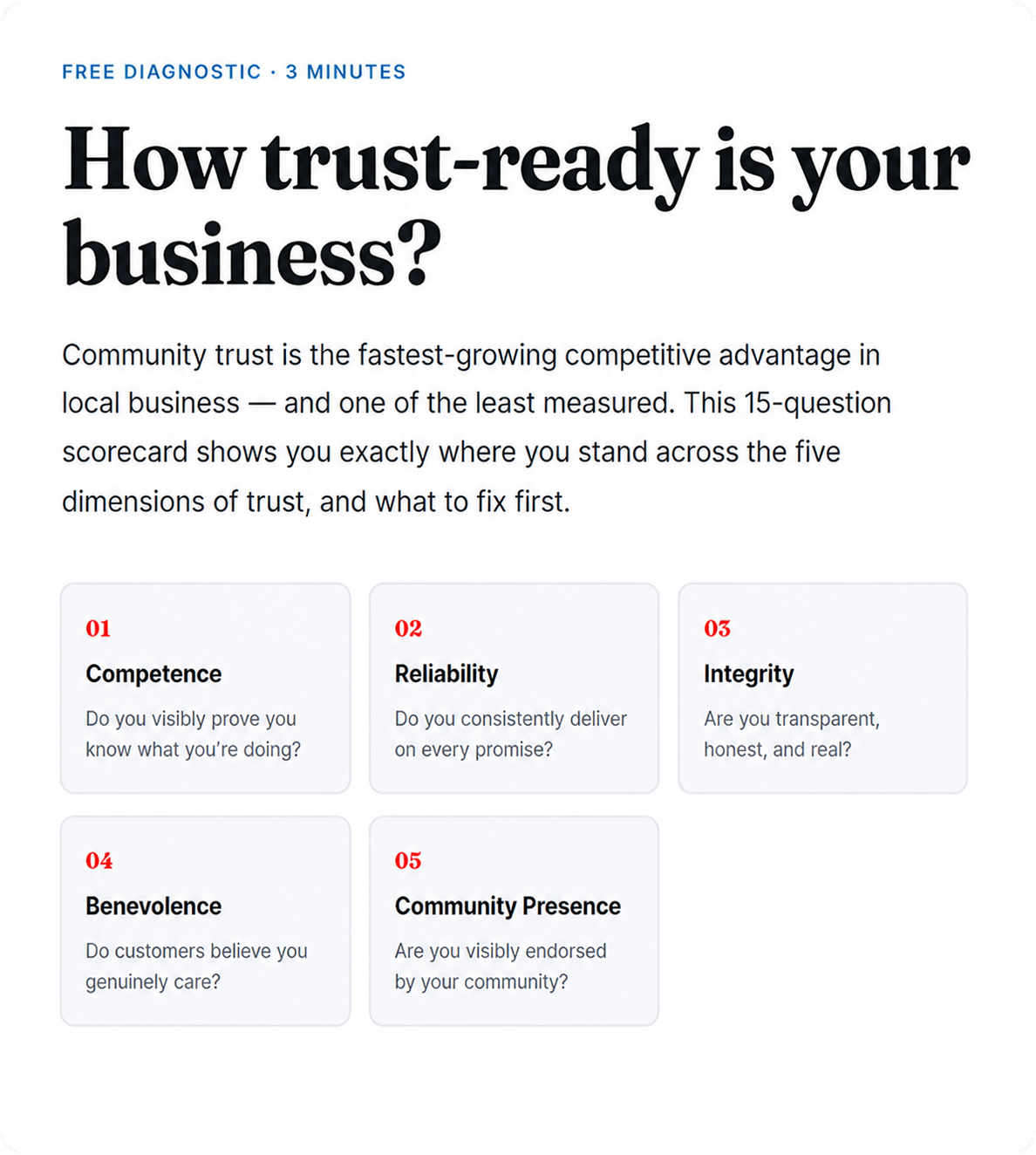
Your prospects and customers evaluate your business on five key dimensions:
Quite often, they reach their conclusion on your trustworthiness in a single moment of truth.
How do you improve your trustworthiness?
It starts with assessing how well you are doing today … and then developing a plan for continuous improvement.
Write down the one place trust broke that you’ve been avoiding looking at.
Not five places. One. The callback problem, the invoice creep, the complaint you answered badly six months ago. Name it specifically, in a sentence, on paper.
That sentence is not your repair. It’s the ground your ladder stands on — and the climb starts next.
Next rung: Language — once you’ve faced where trust broke, you need a shared definition of what you’re rebuilding.
The takeaway: Trust rarely breaks in an explosion. It erodes in silence, and the first discipline of a trusted business is the willingness to look directly at the erosion.
Return to The Trust Ladder Guide.
Discover fresh perspectives on business and innovation
Get the latest strategies, tips, and expert advice delivered directly to your inbox.
By signing up, you agree to our Terms and Conditions.
Join your community and make the world a more trusted place—one review at a time.

Trusti Chief Marketing Officer
Bill Merrow is the Chief Marketing Officer at Trusti, where he writes about how local businesses grow through trusted community recommendations instead of anonymous reviews and paid ads.
A fractional CMO for more than 100 firms worldwide, Bill has led marketing and sales transformations at Cigna Healthcare, American Express, and General Electric — including building a 40,000+ person sales force and an annuity launch that drove $500 million in sales in 18 months.
His work centers on community-led growth, answer engine and SEO visibility, direct-response copywriting, and the referral, recognition, and lifecycle systems that turn happy customers into a business’s most effective sales force.
Bill believes the shortest path to a new customer is still a neighbor’s recommendation — and that marketing’s job is to make that endorsement easier to earn, easier to share, and impossible to ignore.
© 2026 Trusti | All rights reserved