
Most small business owners treat “ask for reviews” and “give back to the community” as two separate line items on a to-do list. One is a growth tactic; the other is a values statement. Neither gets the attention it deserves, and neither produces the return it could — because they were never designed to work together.
According to research compiled by the American Independent Business Alliance (AMIBA), dollars spent at locally owned independent businesses recirculate through the local economy two to four times more than dollars spent at national chains, with roughly 48 percent of each purchase at an independent business cycling back locally compared to about 14 percent at chain retailers. That statistic is not just good news for your neighborhood — it is a competitive advantage you can communicate, and a story your customers genuinely want to be part of. The question is whether you have built a system that gets that story in front of them at the moments when they are most likely to act.
Can a small business really grow just by doing good in the community and asking customers for reviews and referrals?
Yes — but only when those two forces work together. A reciprocity system that asks for reviews and referrals without an underlying community impact story feels hollow, and customers sense it immediately. An impact story without a deliberate reciprocity loop never reaches the people who would amplify it. When you pair a well-designed reciprocity program with a genuine, visible commitment to reinvesting locally, you create a flywheel: proud customers become vocal advocates, advocates bring new customers, and new customers discover the impact story and become proud advocates themselves.
Direct answer
Community impact becomes a growth engine only when it is paired with a reciprocity system — a deliberate loop that asks for reviews and referrals in the same moments you surface your local giving. That multiplier is a story customers want to be part of — but it only travels when you give them an on-ramp to share it.
Source: American Independent Business Alliance — The Local Multiplier Effect (dollars spent at locally owned independent businesses recirculate through the local economy two to four times more than money spent at chains).
Every customer who walks out of your business having had a good experience carries a small amount of goodwill. A reciprocity system — a text asking for a Google review, a referral card tucked in the bag, a loyalty punch card — is designed to fan that ember into a flame. In theory, it works. In practice, many business owners notice that their review requests get ignored, their referral programs generate a trickle instead of a stream, and repeat-visit incentives feel like they are just discounting margin without building loyalty.
The reason is not the mechanics of the ask. It is the absence of a story underneath it. When a customer gets a review request that reads “How did we do? Leave us a review!” they are being asked to do something for you. There is nothing wrong with asking — people understand that reviews matter — but the exchange is fundamentally one-directional. You served them, now they do you a favor. That is a transaction, and transactions do not inspire advocacy.
Customers who become genuine advocates — the ones who recommend you unprompted, who defend you in neighborhood Facebook groups, who bring their colleagues in on a Tuesday afternoon — are not motivated by a punch card. They are motivated by identity. They want to support this business because supporting this business says something about who they are and what they care about. A reciprocity system without a community impact story cannot give them that. All it can do is remind them you exist and hope they comply.
The result is an ask-fatigue cycle. The more often you prompt without giving customers a reason to feel proud, the more they tune out the prompts. Your review count creeps upward but slowly. Your referral program requires constant manual effort to sustain any momentum. You keep adding new incentives hoping the next one will break through, and none of them do — because the missing ingredient was never the incentive. It was the meaning.
Now flip the problem. Maybe you do have an impact story. You sponsor the youth soccer league. You hired three people from the neighborhood. You buy produce from a local farm. You donate a percentage of every sale to the school fundraiser. These are not small things. They are real commitments that cost real money and reflect real values. So why is it that most of your customers do not know about them — and even the ones who do are not talking about your business more because of them?
The answer is that impact without a reciprocity loop is a tree falling in a forest. Your commitment is genuine, but there is no system routing it into the conversations where it would matter most. A customer who sees a small sign by your register saying “We sponsor Little League” may feel a brief warmth toward you. But that warmth evaporates before they reach their car, because nothing in the experience invited them to act on it or share it.
Impact is also easy to dismiss as marketing if it is not woven into the texture of the customer relationship. When your impact story lives only in a frame on the wall or a footer on your website, it feels like a badge you earned rather than a value you live. Customers are perceptive. They can tell the difference between a business that gives back because it looks good and one that gives back because that is who the owner is. But they can only tell the difference if the impact shows up in human moments — in the way you talk about your team, in the reason you give when you ask for a referral, in the follow-up note after a purchase.
Without a reciprocity structure, even a genuinely impactful business is invisible. Your best customers are not telling neighbors about you not because they do not care about your impact, but because nothing in your customer experience gave them a convenient on-ramp to the conversation. No one prompted them. No one reminded them. No one made the connection between “I had a great experience here” and “this is a business worth talking about because of what it puts back into the neighborhood.”
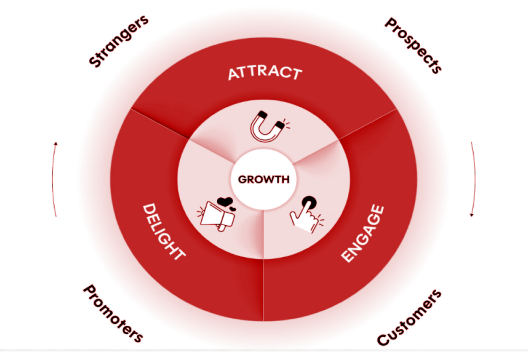
A flywheel, in the mechanical sense, is a wheel that stores rotational energy. Once it gets moving, it takes less and less energy to keep spinning. The growth flywheel you can build by combining reciprocity and impact works exactly the same way — and once you understand the mechanics, you can design your business around them deliberately.
Here is what the flywheel looks like in motion. A new customer walks in, referred by a neighbor. They notice that the team working there is recognizably local — they went to the same high school, live a few streets over. After the transaction, they receive a follow-up message that thanks them and mentions that your business donated to the neighborhood food bank as part of last month’s sales. A week later, they get a gentle review request that notes how much reviews help a locally rooted business compete with the big players. They leave a review. You respond to that review, and in your response you mention that you just hired another team member from the community. That response is public, and the original reviewer’s friends see it.
Now your impact story is doing the work it was always capable of doing — but it only reached that person because a reciprocity touchpoint put it in front of them at the right moment. And your review request got a response not because of the ask itself but because the customer already felt proud to be associated with what you are building. The flywheel is turning. The next customer referred in already arrives with context. The cycle is shorter, the conversion is easier, and the advocacy is more enthusiastic, because each new customer is entering a relationship with a business that has visible stakes in the neighborhood they share.
The flywheel gains speed every time you add a new touchpoint that connects your impact to your reciprocity ask. It gains speed every time you respond publicly to a review in a way that reinforces your community story. It gains speed every time a customer who referred a neighbor hears back from you that the referral came in — especially if you acknowledge it with something that ties back to your local giving.
The math compounds. The effort per new customer decreases over time, even as the quality of new customers increases, because the people arriving through the flywheel are pre-qualified advocates, not cold strangers.
The practical challenge is designing specific touchpoints — review requests, referral asks, repeat-visit prompts — that do not just request action but connect that action to your impact story. This does not require a complete overhaul of your operations. It requires deliberately writing your community story into the moments where you already ask for something.
Start with your review request. Most review prompts are generic: “We’d love a review on Google!” Change the language. “Your review helps a locally owned business — one that hired from the neighborhood and donates a portion of every sale to [specific cause] — compete for customers who might otherwise go to a chain. If we earned it, a few words mean the world.” That version gives the customer a reason beyond basic customer-service courtesy. It positions the review as an act of community support, not a favor to you personally. Customers who are already warm to your business will respond to that framing at meaningfully higher rates.
Your referral program needs the same treatment. Instead of a standard discount-for-referral structure, tie the incentive to your impact. “Refer a neighbor and we’ll make a donation in your name to [local cause].” Or frame the referral as helping a local business stay independent: “Every referral keeps us from having to compete on price with companies that have no stake in this neighborhood.” The customer who refers a friend now has a story to tell — and storytelling is the currency of word-of-mouth.
Think about your repeat-visit touchpoints as well. If you send a re-engagement message to customers who have not been in recently, include a line about what has changed: a new local hire, a new community partnership, a milestone your team just reached. Give them a reason to come back that is about more than a deal. People return to businesses that are alive, that are growing, that are part of something. Your follow-up message is an opportunity to show that you are all three.
Finally, train your team — or, if you are a solo operator, train yourself — to mention your community investments naturally in conversation. Not as a pitch, but as context. “We just brought on someone from the neighborhood” is a sentence that fits naturally into dozens of customer interactions. It costs nothing. It plants the seed of the impact story in a moment that feels human rather than promotional. Those seeds are what grow into reviews and referrals when the reciprocity touchpoints arrive later.
There is a version of community impact communication that makes customers’ eyes glaze over or, worse, makes them roll their eyes. It tends to involve press-release language (“We are proud to announce our commitment to…”), vague claims (“We support our community!”), or impact stories that are clearly more about brand positioning than about the people involved. Customers know the difference, and if your impact communication triggers the wrong signal, it will undermine your reciprocity system rather than fuel it.
The antidote is specificity and humanity. Instead of “We support local causes,” say “We sponsored the Eastside Little League and watched three of our neighbors’ kids play in the championship last month.” Instead of “We hire locally,” say “Four of our five team members grew up within two miles of this location.” Specific details make impact stories real. They give customers something to visualize and something to repeat. Abstract claims do not travel; specific stories do.
Keep your impact communication in the first person and make it conversational. The best place for it is not a framed certificate or a website page — it is the postscript of a follow-up email, a casual mention in a review response, a line in the text you send after a first purchase. These are the moments when your relationship with the customer is active, when they are paying attention, and when a well-placed sentence lands rather than scrolling past.
Your review responses are one of the most underused impact communication channels available to you. Every response is public. When you respond to a five-star review and say “Grateful for your support — it’s what lets us keep investing in our team and our neighborhood,” you are broadcasting your impact story to every future customer who reads that review thread. Respond to every review, positive and negative, and use those responses to reinforce the story you want told about your business. This is not spin — it is strategy.
Also resist the urge to lead with impact. Customers come to you for the quality of your product or service. Impact is the reason to stay loyal and to advocate, not the reason to make a first purchase. Earn the transaction first. Then give people the story that turns a satisfied customer into a proud ambassador.
Trusti is built around seven TRUST Pillars, and two of them — Reciprocity and Impact — are designed to work in exactly the reinforcing relationship described in this post. When your business profile on Trusti reflects strong performance on both pillars, the platform recognizes the combination in ways that surface you more prominently to local customers who are specifically looking for businesses they can trust and feel good supporting.
Reciprocity on Trusti is tracked through the signals that indicate you are actively cultivating a mutual relationship with your customer base: review volume and recency, referral activity, documented repeat-customer patterns, and your own responsiveness to customer feedback. Impact is tracked through your demonstrated reinvestment in the local community — hiring practices, charitable partnerships, sponsorships, and supplier relationships that keep money circulating locally. The platform is designed to reward businesses that score well on both because, as this post argues, the combination is qualitatively different from strength in either pillar alone.
Practically, this means that optimizing for both pillars simultaneously is not twice the work — it is the same work, because the touchpoints that build your Reciprocity score are the same touchpoints where you surface your Impact story. Every review request is an opportunity to mention a community investment. Every referral is an opportunity to tie your ask to a local cause. Every public review response is a data point on both pillars at once. Trusti recognizes that integration and rewards it, which means that the flywheel you build in your day-to-day customer relationships also builds your platform standing and makes you more discoverable to the next customer who is deciding where to spend money in your category.
The businesses that perform best on Trusti are not necessarily the ones with the most reviews or the biggest charitable budgets. They are the ones who have made reciprocity and impact part of the same story — the ones whose customers can feel, in every interaction, that this business is of the neighborhood and accountable to it. Those businesses earn trust faster, retain customers longer, and grow through advocacy rather than advertising.
Reciprocity, in the context of a local business, is a broader and more intentional practice than simply requesting reviews. It is the ongoing effort to create a mutual relationship with your customers — one where you give something of genuine value (quality service, community investment, recognition, responsiveness) and then invite customers to give back in kind through reviews, referrals, and repeat business. Asking for a review is one tactic within a reciprocity system, but the system is what gives the tactic its power. Without a sense of mutual investment, a review request is just a cold ask. Within a well-designed reciprocity loop, it is a natural next step in a relationship that the customer already values.
The key is specificity and conversational placement. Rather than making formal announcements about your giving or partnerships, fold your impact story into the moments of natural customer contact — a follow-up message, a review response, a casual conversation with a team member. Lead with the human detail, not the headline: name the cause, the person, the neighborhood. And keep the framing community-centered rather than self-congratulatory. “We sponsor the school reading program because half our team went to that school” lands very differently than “We are proud to be a community partner.” The first is a story. The second is a press release.
Absolutely — in fact, solo operators often have a significant advantage because their identity is the business’s identity, and customers find it easier to feel personally connected to a real individual. The flywheel does not require a marketing team or a large budget. It requires consistent language in your follow-up touchpoints, deliberate responses to every review, and one or two community investments you can talk about honestly. Even sponsoring a single local event or hiring one person from the neighborhood, when communicated consistently through every reciprocity touchpoint, gives you an impact story that customers can rally around.
Most business owners start to notice a shift in three to six months of consistent execution — not because the flywheel is spinning fast yet, but because they start receiving reviews that mention their community involvement unprompted, which means the story is beginning to travel on its own. Full flywheel momentum, where a meaningful portion of new customers arrive pre-aware of your impact and already predisposed to advocate, typically takes twelve to eighteen months of steady work. The compound returns arrive later, but they arrive reliably. The owners who give up at month four are the ones who never experience the acceleration.
The mechanics are the same, but the emphasis may shift. Service businesses — contractors, salons, personal trainers, repair shops — often have longer individual customer relationships and more natural moments for face-to-face reciprocity. Impact is most powerful when it shows up in how the business treats its employees and which local vendors it uses. Product-based businesses tend to have shorter transaction windows and higher volume, which makes post-purchase digital touchpoints more important. The review request, the follow-up email, and the referral card do more of the heavy lifting. In both cases, the core principle holds: your impact story needs a vehicle, and your reciprocity system needs a story.
Reciprocity and Impact are two of the seven TRUST Pillars at the heart of Trusti, and they are the two most likely to compound when you treat them as a system rather than two separate initiatives. If you are ready to build the kind of local reputation that grows through advocacy — where your customers become your most effective marketing team because they are genuinely proud of what your business does for the neighborhood — the place to start is your profile on Trusti.
Claim your business, build your TRUST Pillar scores, and connect with customers who are actively looking for businesses they can trust and support for the long term. Visit Trusti to get started.
Discover fresh perspectives on business and innovation

Get the latest strategies, tips, and expert advice delivered directly to your inbox.
By signing up, you agree to our Terms and Conditions.
Join your community and make the world a more trusted place—one review at a time.

Trusti Chief Marketing Officer
Bill Merrow is the Chief Marketing Officer at Trusti, where he writes about how local businesses grow through trusted community recommendations instead of anonymous reviews and paid ads.
A fractional CMO for more than 100 firms worldwide, Bill has led marketing and sales transformations at Cigna Healthcare, American Express, and General Electric — including building a 40,000+ person sales force and an annuity launch that drove $500 million in sales in 18 months.
His work centers on community-led growth, answer engine and SEO visibility, direct-response copywriting, and the referral, recognition, and lifecycle systems that turn happy customers into a business’s most effective sales force.
Bill believes the shortest path to a new customer is still a neighbor’s recommendation — and that marketing’s job is to make that endorsement easier to earn, easier to share, and impossible to ignore.


© 2026 Trusti | All rights reserved