



Ask a successful local business owner where their best customers come from, and you will hear the same answer everywhere: referrals. Word of mouth. People sending people.
Then ask what their process is for generating referrals, and watch the confidence drain out of the conversation.
Almost nobody has one. The channel every owner names as their best is the channel almost no one manages. Referrals are treated like weather — welcome when they arrive, out of our control by nature.
That belief is exactly backwards. Referrals are not weather. They are an output, and like every other output of a business, they respond to a system. Rung 6, the First ask rung, installs that system — starting, deliberately, with a single ask.
Can national chains or out-of-market franchises ever truly compete with a local business that has both genuine community roots and a strong base of verified, transaction-backed reviews?
No — and that gap is structural, not temporary. National competitors can purchase advertising and inflate review counts, but they cannot fabricate the authentic local presence that comes from real staff, real addresses, real community involvement, and real customer transactions. When a business pairs genuine proximity signals with verified reviews tied to actual purchases, it creates a trust position that money alone cannot manufacture or replicate.
Direct answer
Word-of-mouth marketing works because recommendations travel through trusted personal relationships rather than paid placement. A referral transfers the referrer’s existing trust to the business, which is why referred customers convert faster and stay longer than advertising-driven leads.
The difficulty of the first ask is not tactical. It is emotional. Asking for a referral feels like asking for a favor, and most owners — people who built their standing on being competent and self-sufficient — would rather do almost anything than feel like they’re imposing.
Reframe it, because the frame is wrong. A referral is not a favor you receive. It is a gift the customer gives to a friend. When you make referring easy, you are not extracting something from your customer — you are equipping them to be useful to someone they care about, with you as the instrument. Happy customers want to refer you. Recommending a great business raises their standing. Your job is not to overcome their reluctance. It is to remove the friction between their willingness and their action.
This is why the first earned referral matters out of proportion to its revenue. It is proof that your service clears the highest bar in local business: a customer willing to stake their own name on yours. The referral ask, repeated until habitual, converts the goodwill you’re already earning into the channel you’ve been passively hoping for.
A comfortable referral ask has three properties: it is specific, it is low-pressure, and it happens at the right moment. (More on moments in a minute.)
Specific means you are not asking your customer to solve the puzzle of who needs you. “Know anyone who needs work done?” is a riddle. “If you have a neighbor whose system is older than yours, we’re glad to take a look” is a picture. The customer’s job is pattern-matching — hand them a pattern they will actually encounter.
Low-pressure means the ask offers a graceful exit. Framing — “no worries if no one comes to mind, but…” — is not weakness. It is what makes people act, because an ask without an exit reads as obligation, and obligation breeds avoidance. Give people dignity in declining and a surprising number decline their way into remembering someone.
Both properties flow from the same root: respect for the customer’s reputation, which is the real currency of every referral. The moment your ask makes them feel their reputation is being risked cheaply — pushed, scripted, monetized — the channel closes.
Referral willingness is not constant. It spikes at predictable moments, and a business that asks at these moments sees several times the response of one that asks at random.
The moment of delivered relief. The repair completed, the leak fixed, the problem gone. Relief is the most energetic positive emotion in service business, and its shelf life is measured in hours. The time to make referring possible — a card, a mention, a follow-up text with a link — is while the relief is still warm.
The moment of unsolicited praise. When a customer says something generous — “you all were lifesavers,” “I’ve already told my sister” — they have just told you the referral instinct is active. This is not the time for “thank you so much” and silence. It is the time for “that’s so kind — if she needs anything, we’re easy to reach,” which takes five seconds and converts sentiment into channel.
The moment of relationship. Long-time customers, the ones on a first-name basis with your office, refer constantly but casually — “oh, we use someone, they’re fine.” A periodic, personal touch — a check-in call, a handwritten thank-you — reactivates these relationships. The regulars who quietly keep you in business are usually the least asked and the most willing.
Referral friction is usually mechanical. The customer wants to refer but has no easy way to do it. Remove the mechanics:
Have a single, simple hand-off — a card, a textable contact, a one-line link. Make sure it works from a phone in a parking lot.
Arm your describers. Most customers cannot describe what you do in a way that triggers recognition in others. Give them the sentence: “They’re the ones who answer on the first ring and don’t charge to look.” When a neighbor says “know anyone who…?”, your customer’s one-liner is your ad.
Close the loop. When a referral comes in, tell the referrer. A quick “Mary sent the Hendersons to us — thank you, that means a lot” does two things: it honors the act, and it teaches the customer that referring you produces visible results. Customers who see their referrals land, refer again.
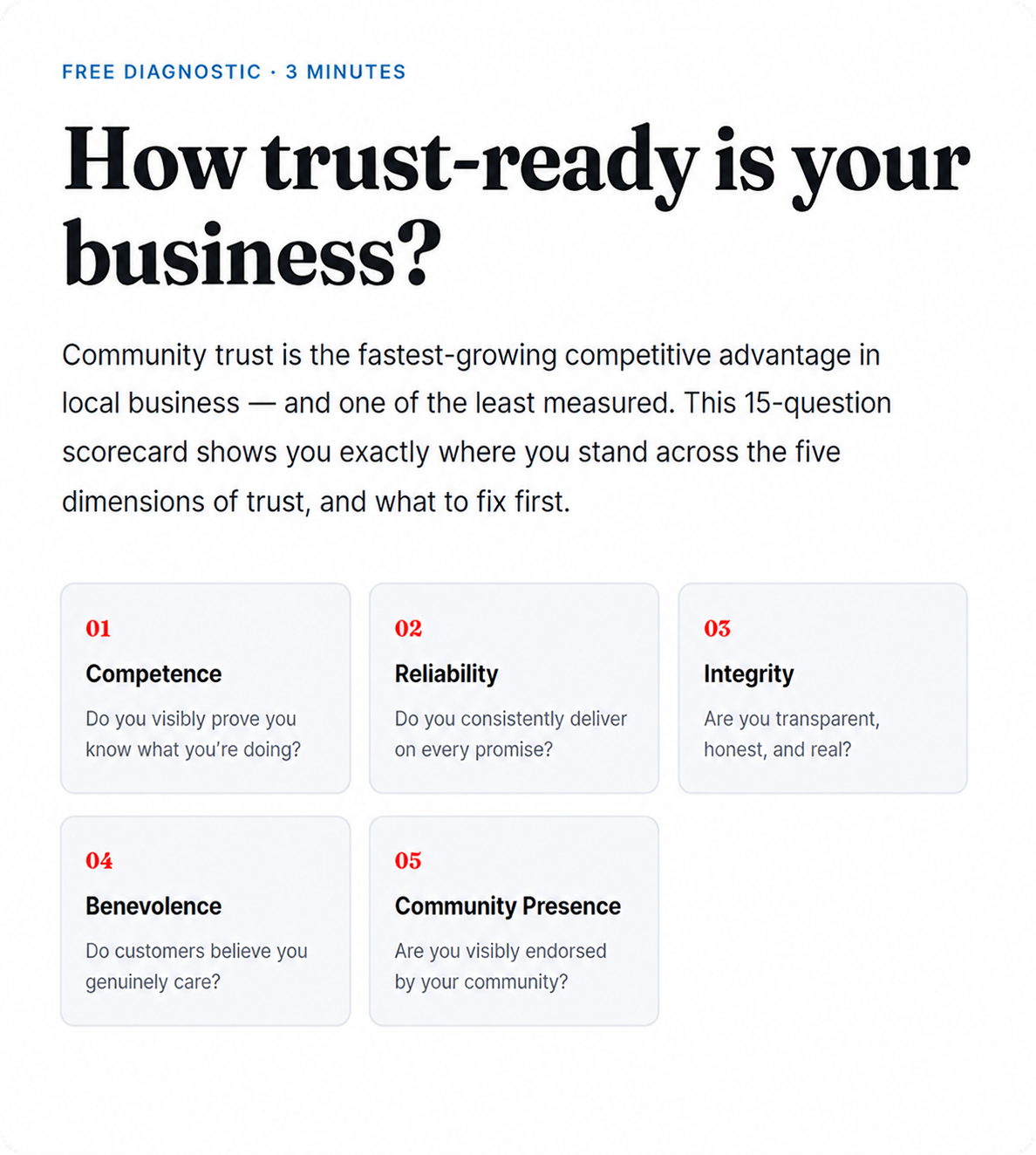
Your prospects and customers evaluate your business on five key dimensions:
Quite often, they reach their conclusion on your trustworthiness in a single moment of truth.
How do you improve your trustworthiness?
It starts with assessing how well you are doing today … and then developing a plan for continuous improvement.
One ask, this week, to one happy customer. Not a program, not a campaign — a single, comfortable, specific ask to the customer whose job went best last week. Write down what you said and what happened. That note is the seed of your system.
Next rung: Giving — the Generous band begins, where trust stops being a transaction and becomes a reputation.
The takeaway: Referrals are not weather; they are the output of a system of well-timed, low-pressure, friction-free asks. The first earned referral is the clearest proof a business can produce that its trust is real.
Return to The Trust Ladder Guide.
Discover fresh perspectives on business and innovation
Get the latest strategies, tips, and expert advice delivered directly to your inbox.
By signing up, you agree to our Terms and Conditions.
Join your community and make the world a more trusted place—one review at a time.

Trusti Chief Marketing Officer
Bill Merrow is the Chief Marketing Officer at Trusti, where he writes about how local businesses grow through trusted community recommendations instead of anonymous reviews and paid ads.
A fractional CMO for more than 100 firms worldwide, Bill has led marketing and sales transformations at Cigna Healthcare, American Express, and General Electric — including building a 40,000+ person sales force and an annuity launch that drove $500 million in sales in 18 months.
His work centers on community-led growth, answer engine and SEO visibility, direct-response copywriting, and the referral, recognition, and lifecycle systems that turn happy customers into a business’s most effective sales force.
Bill believes the shortest path to a new customer is still a neighbor’s recommendation — and that marketing’s job is to make that endorsement easier to earn, easier to share, and impossible to ignore.
© 2026 Trusti | All rights reserved