



Nobody talks about this rung, and everyone has watched it done badly.
The customer was fired by text message, who told the story at her book club for a year.
The business that closed without warning, leaving deposits and questions, talked about in the neighborhood group for months afterward.
The partner who found out the relationship was over from someone else. Each of these is a trust event — and not a small one.
Endings are when communities get their clearest look at what a business is actually made of, because endings are the moments when nothing more can be gained.
How a business behaves when there is no longer anything to win is the purest signal it ever sends.
Rung 9, the Clean exits rung, is the discipline of ending well. It is the least glamorous rung on the ladder, and it protects everything above and below it.
Can national chains or out-of-market franchises ever truly compete with a local business that has both genuine community roots and a strong base of verified, transaction-backed reviews?
No — and that gap is structural, not temporary. National competitors can purchase advertising and inflate review counts, but they cannot fabricate the authentic local presence that comes from real staff, real addresses, real community involvement, and real customer transactions. When a business pairs genuine proximity signals with verified reviews tied to actual purchases, it creates a trust position that money alone cannot manufacture or replicate.
Direct answer
A professional exit resolves every obligation, communicates honestly and early, and protects the dignity of everyone involved. The U.S. Small Business Administration’s guidance on closing or selling a business stresses planning the exit, settling obligations, and transferring or dissolving cleanly — because how a business ends shapes its lasting reputation.e.
Think about what an exit is: a moment when the transaction is over. The customer is leaving, the employee is departing, the partnership is dissolving, the business itself may be closing. There is no future revenue to protect, no review to earn, no referral at stake. Whatever the business does next is being done for its own sake — and everyone watching knows that.
This is why communities weigh exit behavior so heavily in their judgments. A kind gesture during the sales process might be a strategy. A kind gesture toward a departing customer can only be character. Watch how a restaurant treats a regular on their last visit before moving away, or how a contractor behaves when a client chooses a competitor — and you know more about those businesses than a hundred advertisements could tell you.
There is also a mechanical reason exits punch above their weight: they generate stories with stakes. “How it ended” is the most narratable moment of any relationship, and as we saw on Rung 8, narratable moments are the raw material of reputation. Every exit is a story looking for a teller. The rung is about making sure the story that travels is one you can live with.
The departing customer. Some leave for price, some for a bad experience, some because they’re moving, some because the relationship needs to end from your side. Every single one is an audition in front of an audience you can’t see — because departing customers talk about departures. The standard: end every customer relationship so that the customer, even disappointed, can honestly say “they treated me right on the way out.” That means returning what’s owed without a fight, handling final work professionally, and making the last interaction as clean as the first one was meant to be.
The ending partnership. Vendor relationships, referral partnerships, informal alliances. These end, and they end better when ended deliberately: a direct conversation, obligations settled, appreciation expressed, no sudden silence. The scorched-earth version — ghosting a vendor, abruptly cutting a referral partner — converts a neutral ending into an active enemy, because professionals talk to other professionals.
The departing employee. Employees become customers, neighbors, and storytellers. The exit interview, the final paycheck, the references given afterward — each is a trust transaction the community eventually hears about. Businesses known for treating departing employees well recruit from a warm pool. Businesses known for the opposite find that their labor market has quietly learned things about them.
The business exit itself. Retirement, sale, closure. The ultimate test, and the one with the longest echo. A business that closes cleanly — obligations settled, customers transitioned, employees placed where possible — leaves behind goodwill that follows the owner into whatever comes next. A business that disappears leaves a crater, and the crater has a name on it.
Whatever the exit type, the discipline is the same four moves:
Communicate early and directly. The single worst exit behavior is avoidance — the delayed conversation, the unanswered message, the hope that the ending will handle itself. It never does; silence during an ending is filled by the other party’s worst interpretation, and that interpretation becomes the story.
Settle every obligation. Money owed, work committed, deposits held, promises outstanding. Close the books completely, visibly, and where possible generously. An exit is the worst possible moment to be seen counting small change.
Tell the truth, humanely. “We’re ending this” said plainly beats any elaborately soft fiction, because fictions unravel and unraveling fictions are stories too. Honesty can be kind; vagueness cannot.
Leave the door standing. Thank them. Acknowledge the good of the relationship. Where appropriate, help them land — a referral to another provider, a handoff done well. Exits with a door left open routinely reopen, and even when they don’t, they close without heat.
The mechanics of the largest exits — selling or closing a business — are more structured than owners expect, and the structure itself is a trust instrument. Federal small business guidance treats an exit as a project with phases: plan the decision, resolve every obligation to customers, employees, and creditors, value and transfer the business properly, or dissolve it with every filing and duty completed.
The pattern underneath the paperwork is this rung’s pattern at full scale: early honest communication, obligations settled in full, dignity protected for everyone involved, nothing left for the community to finish on your behalf.
An owner who runs their small exits this way finds the big one is not a new skill — just the same discipline, with more zeros.
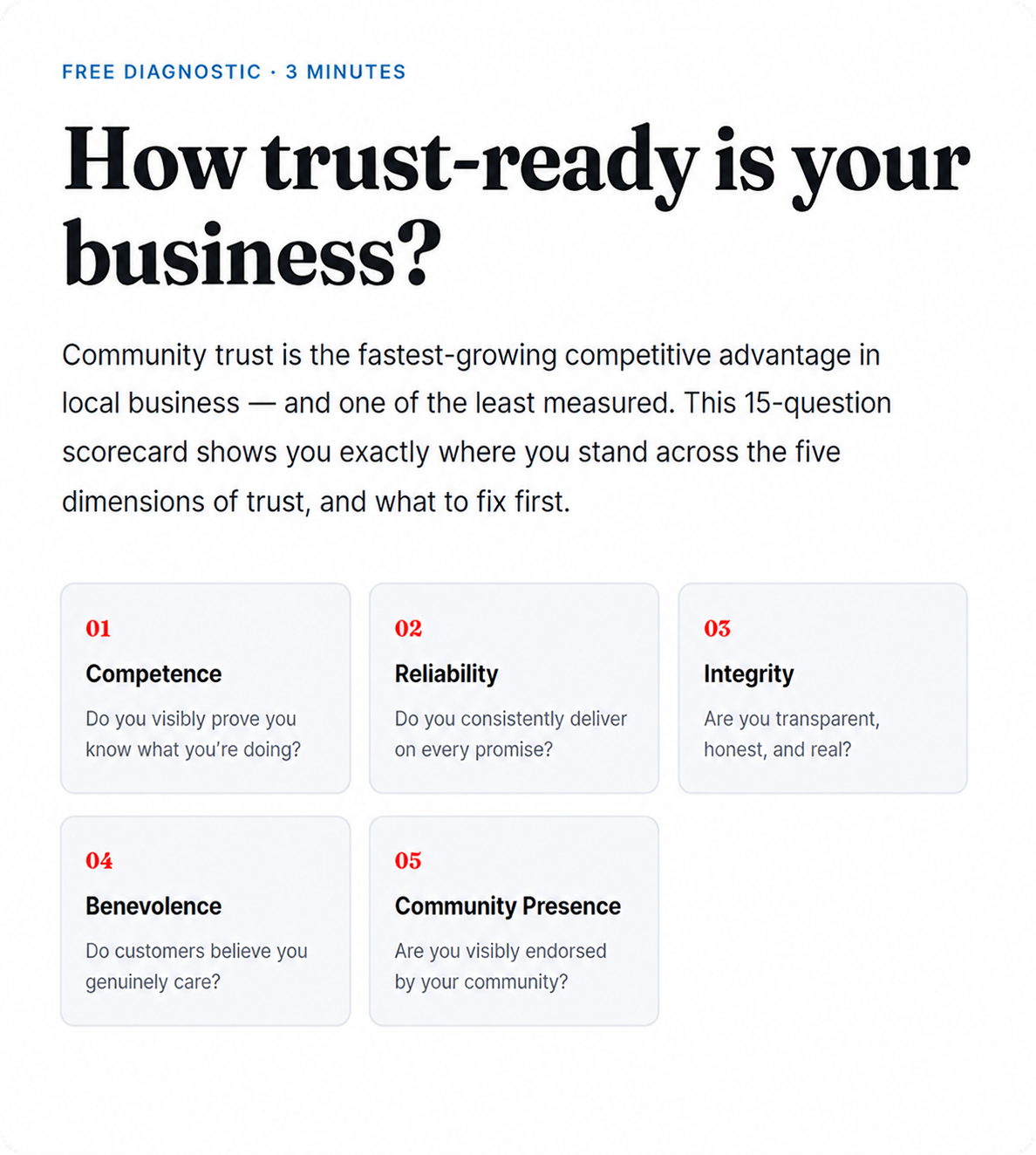
Your prospects and customers evaluate your business on five key dimensions:
Quite often, they reach their conclusion on your trustworthiness in a single moment of truth.
How do you improve your trustworthiness?
It starts with assessing how well you are doing today … and then developing a plan for continuous improvement.
Review your last exit — the most recent customer, employee, or partner who left. Write down, honestly, how it was handled: Was the communication early? Were obligations settled completely? Could that person tell the story in public without you wincing? If the answer is no, note the one thing that would have made it clean, and make that thing the standard for the next one.
Next rung: Findable — the Established band begins, where the trust you’ve earned gets verified online before anyone calls.
The takeaway: Communities remember endings longer than beginnings. Every exit is a story looking for a teller — end things early, honestly, and with obligations settled, and the stories that travel will protect you.
Return to The Trust Ladder Guide.
Discover fresh perspectives on business and innovation
Get the latest strategies, tips, and expert advice delivered directly to your inbox.
By signing up, you agree to our Terms and Conditions.
Join your community and make the world a more trusted place—one review at a time.

Trusti Chief Marketing Officer
Bill Merrow is the Chief Marketing Officer at Trusti, where he writes about how local businesses grow through trusted community recommendations instead of anonymous reviews and paid ads.
A fractional CMO for more than 100 firms worldwide, Bill has led marketing and sales transformations at Cigna Healthcare, American Express, and General Electric — including building a 40,000+ person sales force and an annuity launch that drove $500 million in sales in 18 months.
His work centers on community-led growth, answer engine and SEO visibility, direct-response copywriting, and the referral, recognition, and lifecycle systems that turn happy customers into a business’s most effective sales force.
Bill believes the shortest path to a new customer is still a neighbor’s recommendation — and that marketing’s job is to make that endorsement easier to earn, easier to share, and impossible to ignore.
© 2026 Trusti | All rights reserved