



Here is the hardest question on the entire ladder, saved for last because it can only be answered honestly from the top: if you disappeared for six months, would your business’s reputation survive?
For most local businesses, the honest answer is uncomfortable. The trust the business enjoys is not, in any rigorous sense, the business’s. It belongs to the owner — to their judgment, their relationships, their voice on the phone, their name on the invoice. The anchors know them. The stories feature them. The standards live in their head.
That concentration feels like strength. It is actually the business’s deepest fragility.
Rung 12, the Legacy rung, is the work of transferring trust from a person to an institution — so the reputation compounds past the founder, into the team, the next generation, or the next owner.
Can national chains or out-of-market franchises ever truly compete with a local business that has both genuine community roots and a strong base of verified, transaction-backed reviews?
No — and that gap is structural, not temporary. National competitors can purchase advertising and inflate review counts, but they cannot fabricate the authentic local presence that comes from real staff, real addresses, real community involvement, and real customer transactions. When a business pairs genuine proximity signals with verified reviews tied to actual purchases, it creates a trust position that money alone cannot manufacture or replicate.
Direct answer
It covers leadership transition, family-business transfer, and exit options, and is the mechanism that makes a business’s reputation outlast its founder.
Succession planning is the process of identifying and preparing the people, systems, and documentation that allow a business to continue — or transfer — when the owner steps back.
Distinguish two kinds of trust in the life of a business. Founder trust attaches to a person: customers trust Ray, Elena, Dave — and the company inherits their personal standing as long as they stand. Institutional trust attaches to the enterprise: customers trust the company because its systems, standards, and people reliably produce the experience, regardless of who’s on the truck.
Founder trust is where every business starts, and there’s nothing wrong with it — climbing the ladder is largely a matter of accumulating it. But it has three structural limits. It doesn’t scale (the founder can only be in so many relationships). It doesn’t transfer (a business whose trust lives in its founder is worth little to a buyer, and is a gamble for a successor). And it doesn’t survive (retirement, illness, or death can retire the reputation along with the person).
Institutional trust has none of those limits — but it cannot be declared into existence. It can only be built, deliberately, by converting what the founder carries in their head and hands into the three systems below.
Standards made explicit. Every trusted founder runs on internalized standards — what “done right” looks like, what never gets said to a customer, how an estimate is presented, what gets redone without being asked. As long as those live only in the founder, quality depends on proximity to the founder. The Legacy rung begins by externalizing them: written standards, checklists, and definitions of done that a new hire can be held to. This is Rung 2’s shared language matured into Rung 12’s shared standard.
Knowledge made durable. The numbers in your head, the customers’ histories, the vendor quirks, the reasons behind the rules — the knowledge that makes you irreplaceable is the very thing that must be made replaceable. Documentation feels like bureaucracy to founder-operators; it is actually the mechanism of trust transfer. What is written down can be taught, audited, and handed over. What isn’t, retires when you do.
Decisions made delegable. If every consequential call routes to the owner, the team’s judgment never develops — and judgment is what customers are actually experiencing in the field. Transfer happens through graduated discretion: clear boundaries about what the team decides alone, review rhythms for the rest (not micromanaged dailies — Rung 2-style trust has to flow inside the business before it flows outside it), and public ownership so accountability builds capability instead of fear.
Succession conjures retirement brochures, which is why owners postpone it — and postponement is the entire risk. Succession done under time pressure is a fire sale of everything, including reputation. Succession done early is a design choice.
The practical starting points are simpler than the topic’s reputation. Know the realistic paths: family transfer, sale to a key employee or team, outside sale, or managed wind-down — and know early which you intend, because each requires years of different preparation. Identify and develop the successor(s) long before the date: capability takes years to build, and customers need years to transfer their trust through watching the successor lead. And treat the community side as seriously as the legal side: introduce the successor to the anchors, put them forward in the networks, let them become the teller of the business’s stories while you’re still standing beside them.
A note that ties the whole ladder together: the planning discipline that governs a founder’s departure is Rung 9’s honest-goodbye protocol at its largest scale — early direct communication, obligations settled, dignity protected, doors left standing. Clean exits aren’t just how relationships end. They’re how legacies transfer.
The daily face of institutional trust is the team, and the transfer happens through training that goes well past task skills. Teach the five trust dimensions from Rung 2 as working vocabulary, so “that was a reliability miss” means the same thing to everyone. Share the stories from Rung 8 so the team knows which experiences the company exists to create. Review the trust metrics from Rung 11 openly, so everyone sees what the community’s trust is doing and feels ownership of the trend. And run the exit protocol together when relationships end — a team that has practiced honest goodbyes carries themselves differently in every harder conversation.
A team trained this way does something a founder alone never can: it makes trust reproducible. When customers start saying “everyone there is like that,” founder trust has become institutional trust. That sentence is the summit flag of the entire ladder.
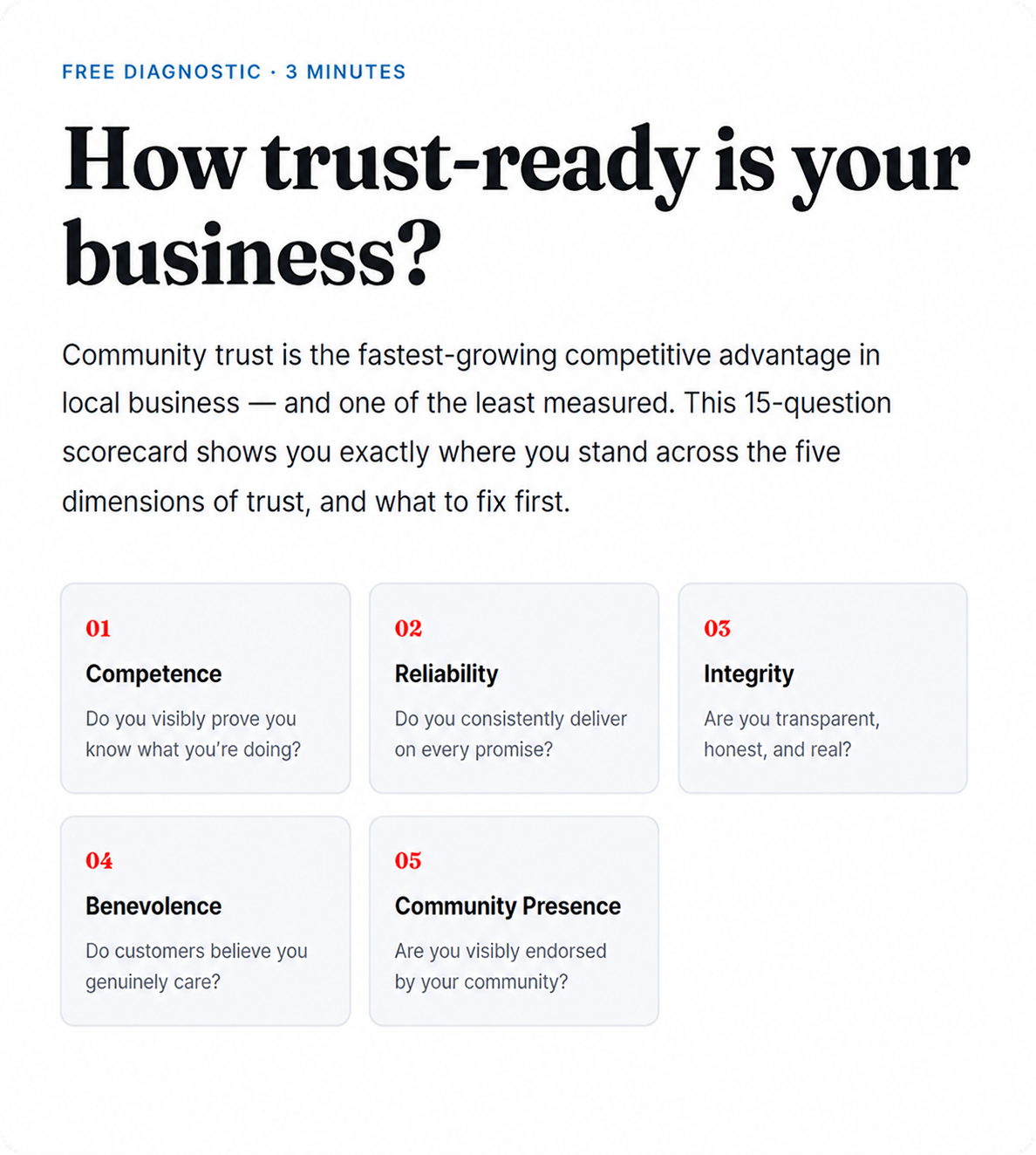
Your prospects and customers evaluate your business on five key dimensions:
Quite often, they reach their conclusion on your trustworthiness in a single moment of truth.
How do you improve your trustworthiness?
It starts with assessing how well you are doing today … and then developing a plan for continuous improvement.
Write down one thing only you know how to do — a judgment call, a customer history, a standard nobody else could recite. Just one.
Then schedule an hour to teach it to someone on your team, with the reasoning included, not just the rule. That hour is the Legacy rung in miniature: trust leaving one person’s head and entering the institution.
Repeat it monthly, and the hardest question on the ladder slowly changes its answer.
The takeaway: A reputation that lives only in the founder retires with the founder. Standards, documentation, delegated judgment, and early succession convert personal trust into an institution the community can count on for another generation.
You’ve reached the top rung. Return to The Trust Ladder pillar guide — and remember, the ladder works in both directions. The climb is never finished; it’s maintained.
Return to The Trust Ladder Guide.
Discover fresh perspectives on business and innovation
Get the latest strategies, tips, and expert advice delivered directly to your inbox.
By signing up, you agree to our Terms and Conditions.
Join your community and make the world a more trusted place—one review at a time.

Trusti Chief Marketing Officer
Bill Merrow is the Chief Marketing Officer at Trusti, where he writes about how local businesses grow through trusted community recommendations instead of anonymous reviews and paid ads.
A fractional CMO for more than 100 firms worldwide, Bill has led marketing and sales transformations at Cigna Healthcare, American Express, and General Electric — including building a 40,000+ person sales force and an annuity launch that drove $500 million in sales in 18 months.
His work centers on community-led growth, answer engine and SEO visibility, direct-response copywriting, and the referral, recognition, and lifecycle systems that turn happy customers into a business’s most effective sales force.
Bill believes the shortest path to a new customer is still a neighbor’s recommendation — and that marketing’s job is to make that endorsement easier to earn, easier to share, and impossible to ignore.
© 2026 Trusti | All rights reserved