



Sit in any local business long enough and you will see the pattern. A customer walks in and says, “Carol at the front desk of Dr. Peterson’s office told me to come here.”
Another says the Rotary president mentioned you. A third was sent by the contractor everyone uses.
These people — Carol, the Rotary president, the contractor — did not coordinate. They are not on a list anywhere.
But together they form the single most important commercial asset in your town: the short list of people whose recommendations actually move decisions. Sociologists have studied them for seventy years and call them opinion leaders. Most locals just call them “the person to ask.”
Rung 4, the Anchors rung, is about finding these people deliberately instead of accidentally — and about earning a place on their mental list through behavior, not pitch.
Can national chains or out-of-market franchises ever truly compete with a local business that has both genuine community roots and a strong base of verified, transaction-backed reviews?
No — and that gap is structural, not temporary. National competitors can purchase advertising and inflate review counts, but they cannot fabricate the authentic local presence that comes from real staff, real addresses, real community involvement, and real customer transactions. When a business pairs genuine proximity signals with verified reviews tied to actual purchases, it creates a trust position that money alone cannot manufacture or replicate.
Direct answer
Opinion leaders are individuals whose status, expertise, or social position makes their recommendations disproportionately influential within a group.
Research on opinion leadership shows ideas flow from the media to these trusted individuals and then to the wider community through personal conversation.
It is worth being blunt about the distinction, because confusing the two is expensive.
An influencer has reach. They command attention — followers, impressions, audience size. Their value is broadcasting.
An anchor has gravity. They command trust — the specific, personal, hard-won kind that exists between people who know each other. Their value is not that many people hear them. It is that the few who do, believe them completely.
The two occasionally overlap, but in a local community they are usually different people, and the local one is worth more to you. A hundred thousand strangers scrolling past a recommendation is worth less — measurably, in your own books, worth less — than eight neighbors acting on the anchor’s word.
The traps come when businesses apply influencer logic to anchors: approaching them with offers, affiliate deals, free services in exchange for endorsement. That approach treats the anchor’s trust as inventory.
Anchors experience it as an insult, because their standing in the community was specifically built by never selling it. Approach them as a customer of their attention and you have identified yourself as someone who does not understand what they are.
Anchors are not a mysterious species. In most communities they sort into six recognizable types, and a working map usually finds two or three of each.
The professional hub. Office managers, school secretaries, medical front-desk staff, town clerks — people whose job is answering “who should I call?” every day. They maintain mental referral lists longer than any directory, and their recommendations carry the weight of their institution without its formality.
The connector trades-person. Contractors, realtors, insurance agents, hairdressers, barbers — people whose work puts them in dozens of homes and hundreds of conversations a month. The hairdresser who has done the same customers for fifteen years knows more local reputation than any database ever will.
The civic officer. Service club presidents, HOA board members, scoutmasters, coaches, ministry leaders. Their recommendations arrive with organizational halo, and their memberships cut across economic lines other networks never bridge.
The longtime host. The diner owner, the barkeep, the gym owner, the shopkeeper whose counter is a confessional. Conversations flow to these people, which means they know who is happy, who is looking, and who got burned last month.
The quiet expert. The retired contractor, the former inspector, the hobbyist everyone consults before a decision. They recommend cautiously and precisely, which makes their rare endorsement nearly definitive.
The digital anchor. The neighborhood group administrator, the local subreddit’s trusted regular, the community Facebook member whose comments get sixty likes. Same gravity, newer medium — and often the first stop for every “does anyone know a good…” question in town.
Block ninety minutes and build the map on paper.
Start with your last fifty customers. For each one who came by referral or mention, write down who sent them — specifically, not “word of mouth.” You will be surprised how much of this you already know and have never aggregated. Patterns emerge fast: certain names recur, certain institutions recur.
Then go outward. For each network you identified on Rung 3, ask who inside it people actually listen to — not who holds the title. The club president may be ceremonial while the past treasurer carries the real weight. Ask around. “Who would you ask before hiring someone?” is a question everyone can answer, and the answers converge.
Finally, rank what you have. For each name, note their type, their network, how many people they plausibly influence, and — critically — whether they know your business at all.
Most owners finish this exercise holding a map of thirty to fifty people who collectively steer most of the community’s commercial trust, alongside the sobering realization that they know perhaps five of them.
That gap is the assignment.
Anchors add businesses to their list the same way everyone forms trust: through observed behavior over time. There is no shortcut, but there is a sequence.
Be visible where they can observe you. Anchors notice businesses in action — at the fundraiser you catered at cost, on the job site they drove past, in how your crew treats a confused elderly customer when nobody important is watching. Every anchor carries a mental ledger, and it is filled almost entirely by unsolicited observation.
Be referenced by people they trust. Remember the multiplier from Rung 3: trust flows through networks. If three people the anchor independently trusts have mentioned your good work, you are already halfway onto the list before ever speaking to them.
Make their recommendation safe. This is the heart of it. Recommending you costs the anchor reputation if you fail. Every anchor has a story about the business that burned them after a referral, and each story raises their bar.
Your job is to be the business whose failures get handled so visibly well that even a miss doesn’t damage the person who sent you. Ask your current referrers directly what would make recommending you feel safest, and then build that.
And when the referral finally comes from an anchor — treat it as what it is: their reputation riding in your truck. The service given to an anchor’s referral should be the best your business can produce, every time, without exception.
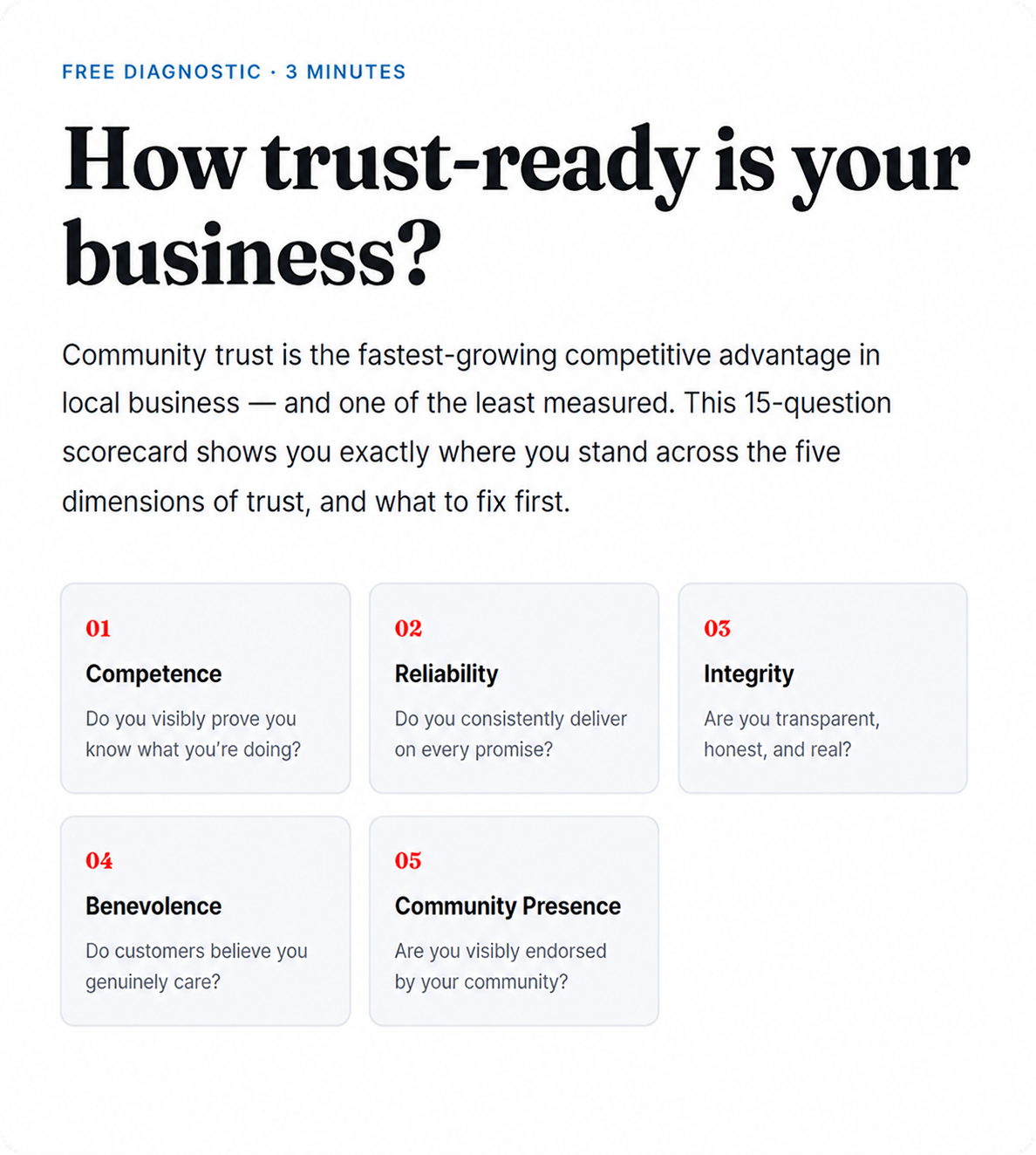
Your prospects and customers evaluate your business on five key dimensions:
Quite often, they reach their conclusion on your trustworthiness in a single moment of truth.
How do you improve your trustworthiness?
It starts with assessing how well you are doing today … and then developing a plan for continuous improvement.
Name your top five anchors — specifically, by name, with their type and network. Do not do anything about them yet. Just write the list where you will see it daily, and add names as they surface. Awareness alone changes what you notice.
Next rung: Signals — the Proven band begins, where private trust becomes visible proof strangers can check.
The takeaway: Every community is steered by a few dozen people whose word carries everyone else’s. They cannot be pitched, only earned — and the map to them is sitting in your own customer history.
Return to The Trust Ladder Guide.
Discover fresh perspectives on business and innovation
Get the latest strategies, tips, and expert advice delivered directly to your inbox.
By signing up, you agree to our Terms and Conditions.
Join your community and make the world a more trusted place—one review at a time.

Trusti Chief Marketing Officer
Bill Merrow is the Chief Marketing Officer at Trusti, where he writes about how local businesses grow through trusted community recommendations instead of anonymous reviews and paid ads.
A fractional CMO for more than 100 firms worldwide, Bill has led marketing and sales transformations at Cigna Healthcare, American Express, and General Electric — including building a 40,000+ person sales force and an annuity launch that drove $500 million in sales in 18 months.
His work centers on community-led growth, answer engine and SEO visibility, direct-response copywriting, and the referral, recognition, and lifecycle systems that turn happy customers into a business’s most effective sales force.
Bill believes the shortest path to a new customer is still a neighbor’s recommendation — and that marketing’s job is to make that endorsement easier to earn, easier to share, and impossible to ignore.
© 2026 Trusti | All rights reserved