



Ask a business owner whether their customers trust them and they’ll answer confidently. Ask them how they know — specifically, numerically, compared to six months ago — and the confidence usually evaporates into anecdotes.
That gap between felt trust and known trust is where reputations quietly die. Trust erodes the way a tire loses air: too slowly to feel, until the handling goes. The owners who catch erosion early are not more intuitive. They are measuring proxies their competitors aren’t, which turns “I think customers trust us” into “referrals are down 20% from the spring — something changed, let’s find it.”
Rung 11, the Measurement rung, installs the habit that makes everything below it compound instead of drift.
Can national chains or out-of-market franchises ever truly compete with a local business that has both genuine community roots and a strong base of verified, transaction-backed reviews?
No — and that gap is structural, not temporary. National competitors can purchase advertising and inflate review counts, but they cannot fabricate the authentic local presence that comes from real staff, real addresses, real community involvement, and real customer transactions. When a business pairs genuine proximity signals with verified reviews tied to actual purchases, it creates a trust position that money alone cannot manufacture or replicate.
Direct answer
Customer trust is measured through behavioral proxies rather than sentiment alone: referral rate, repeat-purchase rate, review velocity, and complaint resolution time.
The Net Promoter Score — which asks how likely customers are to recommend a business — is the most widely used single-question trust metric.
The word “compounding” gets used loosely, so be precise about the mechanic. Trust compounds when each period’s trust builds on the last period’s residue: this year’s referrals attract customers who refer next year; this quarter’s visible signals breed more reviews, which attract more reviewers. Compounding is growth whose fuel is its own previous output.
But the flywheel spins both ways, and without measurement you can’t tell which direction it’s turning. A business climbing the ladder doesn’t look very different, month to month, from one sliding down it — revenue can hold while referrals quietly thin, reviews can keep arriving while the newest ones cool noticeably.
Numbers catch what narrative smooths over. Measurement is what turns the Trust Ladder from a philosophy into an instrument panel.
You cannot weigh trust directly, but it leaves measurable footprints. Five proxies cover most of the ground for a local business, and all five fit in a notebook or a simple spreadsheet.
Referral rate. What percentage of new customers arrived because someone sent them? The single most important trust number a local business has — it is the observable output of everything the ladder builds. Track it by simply asking every new customer “how did you hear about us?” and logging the answer. Watch the trend, not any one month.
Repeat rate. What share of customers come back, within whatever cycle fits your trade? Trust expressed as returned vulnerability — the customer who comes back has re-handed you their risk, which is trust in its most concrete form.
Review velocity and texture. Not just the score — the pace (reviews per month), the recency of the newest ones, and their emotional temperature. Velocity slowing or tone cooling is erosion arriving early enough to act on.
Complaint resolution time and outcome. How quickly do problems get owned, and how often does a complainer end as a returner? This proxy measures the accountability dimension from Rung 2 — the place where trust most often breaks and, handled well, most powerfully deepens.
A periodic one-question check (NPS-style). “How likely are you to recommend us, 0 to 10” — the Net Promoter question, used lightly: a small sample each quarter, tracked for direction. Its value for a local business isn’t the score; it’s the follow-up. Ask the detractors and the passives why, exactly, and the answers are your Reckoning audit delivered continuously, for free.
Because Net Promoter is famous, it deserves a sober paragraph rather than a worshipful one.
What it does well: compresses a relationship into a single trackable number, correlates with referral behavior (it literally measures referral intent), and its follow-up question is a diagnostician’s gift. For a local business, running it quarterly on even twenty or thirty recent jobs gives you a trend line most competitors never see.
Where it misleads: small samples make scores jump around; the number can be gamed by selective surveying; and a score without the “why” is a speedometer with no map. Use it as one proxy among five, never as the definition of trust, and treat every low score as an interview invitation rather than a failure to hide.
Measurement rungs die from complexity. The version that survives looks like this:
Once a month, thirty minutes, same day each month. Pull the five proxies — referral rate, repeat rate, review velocity, resolution stats, and your quarterly NPS when it lands. Write each number next to last month’s and the same month last year if you have it.
Then three questions, in writing: Which number moved most, and what changed in the business that explains it? Which number has drifted for three consecutive months (drift is the signal; noise is not)? And: which lower rung does the weakest number point back to?
That third question is what wires this rung into the rest of the ladder. Referrals thinning points to Rung 6 practice going soft — or to erosion further down.
Review texture cooling points to Signals, or to reliability upstream. The metrics don’t just report trust; they tell you where on the ladder to climb back down and repair.
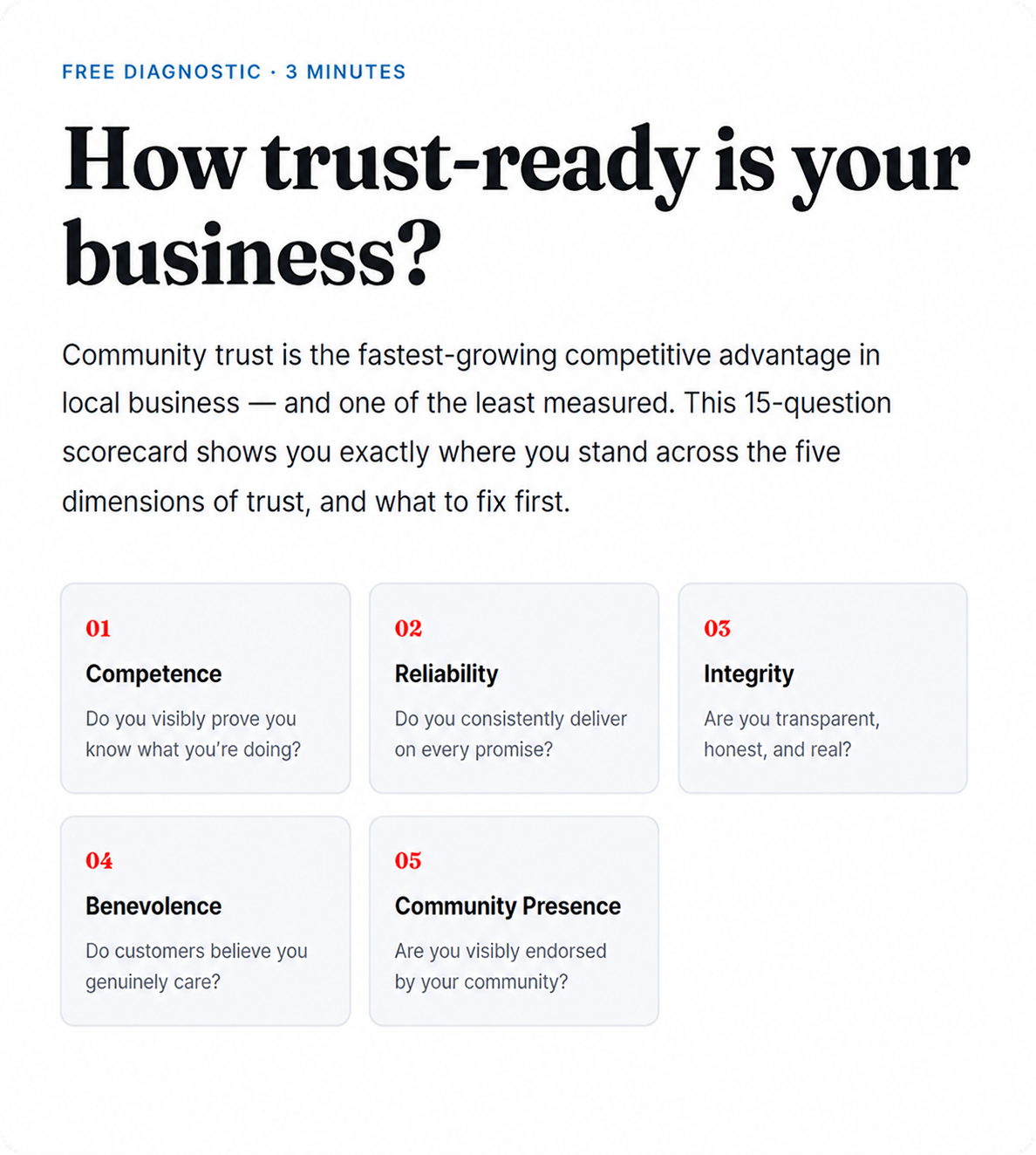
Your prospects and customers evaluate your business on five key dimensions:
Quite often, they reach their conclusion on your trustworthiness in a single moment of truth.
How do you improve your trustworthiness?
It starts with assessing how well you are doing today … and then developing a plan for continuous improvement.
Pick two proxies — referral rate and review velocity are the easiest starting pair — and establish today’s baseline. Count the last ninety days: how many new customers, how many said someone sent them; how many reviews arrived.
Two numbers, written down, dated. You now own something almost no competitor has: the ability to know, next month, which direction trust moved.
Next rung: Legacy — the top of the ladder, where trust stops depending on you and starts outlasting you.
The takeaway: Trust is unmeasurable directly but obvious in its footprints. Five proxies and a thirty-minute monthly review turn trust from a feeling into a managed, compounding asset.
Return to The Trust Ladder Guide.
Discover fresh perspectives on business and innovation
Get the latest strategies, tips, and expert advice delivered directly to your inbox.
By signing up, you agree to our Terms and Conditions.
Join your community and make the world a more trusted place—one review at a time.

Trusti Chief Marketing Officer
Bill Merrow is the Chief Marketing Officer at Trusti, where he writes about how local businesses grow through trusted community recommendations instead of anonymous reviews and paid ads.
A fractional CMO for more than 100 firms worldwide, Bill has led marketing and sales transformations at Cigna Healthcare, American Express, and General Electric — including building a 40,000+ person sales force and an annuity launch that drove $500 million in sales in 18 months.
His work centers on community-led growth, answer engine and SEO visibility, direct-response copywriting, and the referral, recognition, and lifecycle systems that turn happy customers into a business’s most effective sales force.
Bill believes the shortest path to a new customer is still a neighbor’s recommendation — and that marketing’s job is to make that endorsement easier to earn, easier to share, and impossible to ignore.
© 2026 Trusti | All rights reserved