



Something changed in how trust works, and many excellent local businesses haven’t fully registered it.
For most of history, trust was verified in person. Someone heard your name from a neighbor, then called, then met you, and the handshake did the work. Today there’s a step in between that nobody opted into but everybody performs: the check.
The neighbor’s recommendation is followed — almost always, almost immediately — by a search. Your name goes into a phone. What comes back in the next thirty seconds either confirms the recommendation or quietly kills it, and you will never know it happened.
Rung 10, the Findable rung, treats your online presence as what it has become: the doorstep where earned trust gets verified. A business can climb every rung below this one and still lose the referred customer at the threshold if the doorstep is shabby, confusing, or missing.
Can national chains or out-of-market franchises ever truly compete with a local business that has both genuine community roots and a strong base of verified, transaction-backed reviews?
No — and that gap is structural, not temporary. National competitors can purchase advertising and inflate review counts, but they cannot fabricate the authentic local presence that comes from real staff, real addresses, real community involvement, and real customer transactions. When a business pairs genuine proximity signals with verified reviews tied to actual purchases, it creates a trust position that money alone cannot manufacture or replicate.
Direct answer
Local search engine optimization is the practice of making a business visible in location-based search results — principally through a complete and accurate Google Business Profile, consistent business information across the web, and a strong, genuine review profile, which together determine local ranking.
Watch anyone receive a recommendation now and you’ll see the reflex: nod, say thanks, then later — privately, within the day — search. They check the reviews. They glance at photos. They notice whether the business looks current. They may never consciously decide anything; the search just settles a feeling.
Two scenarios show what the doorstep does. In the first, the referral lands on a business with a complete profile, fresh photos, a hundred genuine reviews, and recent responses from the owner.
The recommendation is confirmed; the call follows. In the second, the same referral lands on a profile with a wrong phone number, nine reviews, the newest one fourteen months old, and no response to the unhappy one at the bottom.
Nothing dramatic happens. The customer just … doesn’t call, and tells the referrer “I’ll get to it.” The referrer’s trust was transferred to you, and the doorstep spent it.
The hard truth: this rung does not create trust. It confirms or squanders trust created elsewhere. That is why it sits so high on the ladder — polish the doorstep before there’s a reputation behind it and you have built a beautiful entrance to an empty house.
But with the lower rungs real, the doorstep becomes the multiplier that lets private trust convert at scale.
When the checking reflex fires, five elements get scanned, and inconsistencies among them are the most damaging thing a doorstep can contain.
Name and identity. The business’s name, everywhere it appears, should be the same name. Variations that seem trivial to you — abbreviated here, “LLC” there, an old trade name lingering on a directory — read to a stranger as possible signs of two businesses, or of one that doesn’t mind details.
Contact facts. Phone, address, hours. Wrong hours on a profile don’t just inconvenience a stranger; they demonstrate that the business isn’t tending its own front door, which invites the question of what else isn’t tended.
Reviews. The doorstep’s main texture, covered in full on Rung 5. Here the key is coherence: the review profile should confirm the story the referrer told, including the owner’s visible, professional voice in the responses.
Photos and activity. Current, real photos of work, premises, and people — not stock — answer the stranger’s quiet question: is this business alive? A profile untouched for a year answers it the wrong way regardless of reality.
The website behind it all. For the stranger who clicks through, the site is the interior behind the doorstep. It needn’t be fancy. It must be current, consistent with everything above, and easy to act on — the call, the form, the directions, findable in seconds on a phone.
The center of the local doorstep, for nearly every local business, is the Google Business Profile. It is usually the first thing a searcher sees, often the only thing, and the fundamentals are unglamorous and decisive.
Claim and verify the profile. Fill every applicable field completely — categories, services, service area, description, attributes — because completeness is both a ranking factor and a trust cue. Keep hours current, including holidays, since wrong hours are the fastest way to convert a check into a disappointment.
Add real photos regularly; profiles with fresh, genuine imagery visibly outperform neglected ones. Answer questions in the Q&A section before others answer them for you. And respond to reviews there first — it is the venue strangers check most.
Beyond Google, the discipline is consistency: the same name, phone, and address across every directory and platform where you appear. Search engines read consistency as legitimacy, and so — subconsciously — do people. Fixing drift across a dozen listings is tedious, one-time, and quietly one of the highest-leverage hours in local marketing.
One more synthesis before moving up the ladder: reviews live at the intersection of Rung 5 (making trust visible) and this rung (making the verification moment convert). The same asset does both jobs, which is why a genuine, growing review profile is the single most valuable piece of digital real estate a local business owns — and why the FTC-grade honesty discipline from Rung 5 matters doubly here. A doorstep built on fake signals isn’t just unethical; it’s load-bearing fakery, and its collapse takes the whole Established band with it.
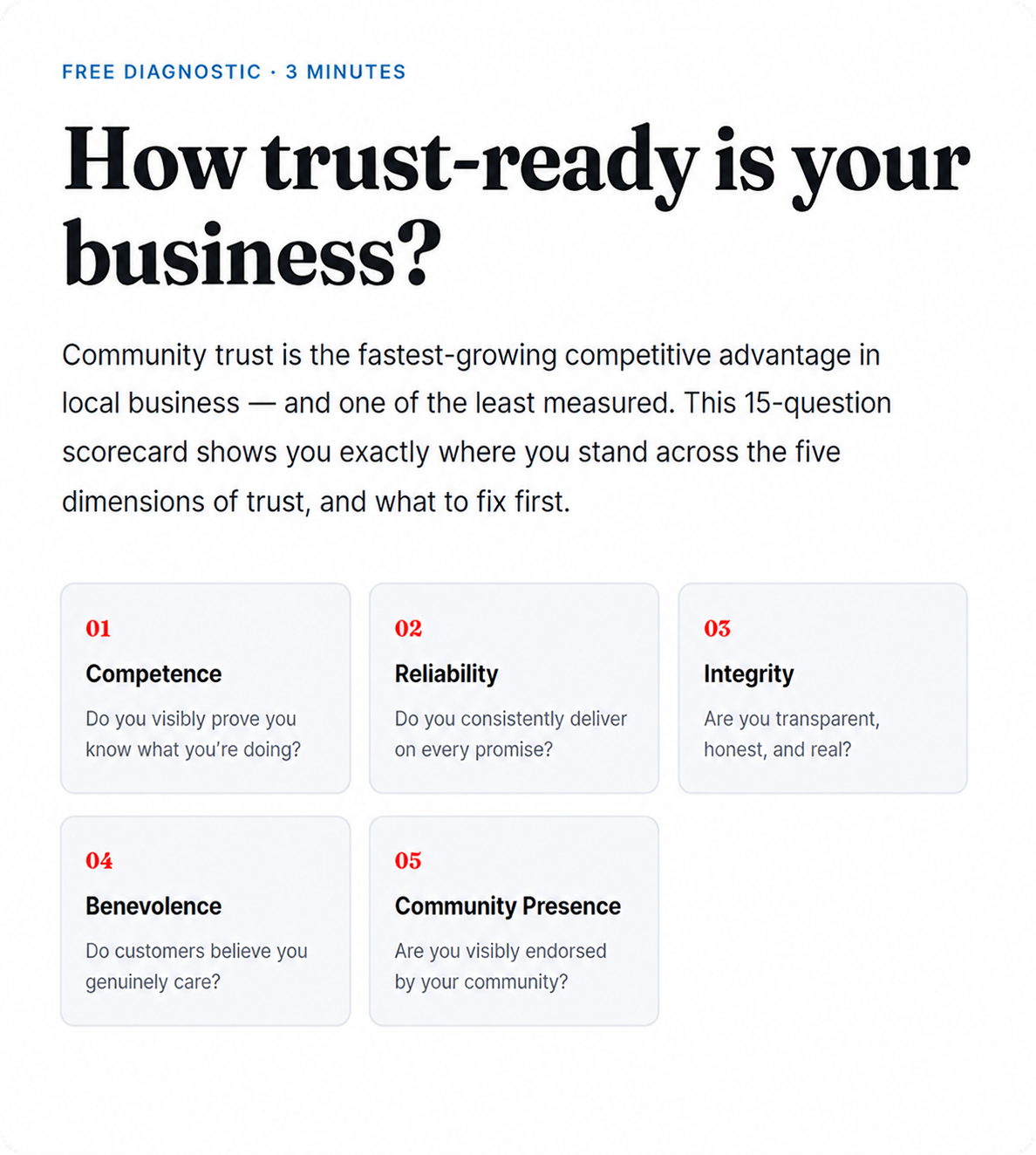
Your prospects and customers evaluate your business on five key dimensions:
Quite often, they reach their conclusion on your trustworthiness in a single moment of truth.
How do you improve your trustworthiness?
It starts with assessing how well you are doing today … and then developing a plan for continuous improvement.
Run the 20-minute consistency audit. Search your business name the way a referred stranger would. Note: Are the top results consistent on name, phone, and hours? When was the newest review, photo, or post? Does the website match the profile, and can a stranger act from a phone in ten seconds? Write down every gap, no matter how small. Then fix the two that would embarrass you most if a referrer’s friend saw them tonight.
Next rung: Measurement — the doorstep converts trust; now learn to measure trust so it compounds instead of quietly eroding.
The takeaway: Trust today is earned in person and verified online. Build the doorstep so every recommendation you earn is confirmed in 30 seconds by a stranger with a phone.
Return to The Trust Ladder Guide.
Discover fresh perspectives on business and innovation
Get the latest strategies, tips, and expert advice delivered directly to your inbox.
By signing up, you agree to our Terms and Conditions.
Join your community and make the world a more trusted place—one review at a time.

Trusti Chief Marketing Officer
Bill Merrow is the Chief Marketing Officer at Trusti, where he writes about how local businesses grow through trusted community recommendations instead of anonymous reviews and paid ads.
A fractional CMO for more than 100 firms worldwide, Bill has led marketing and sales transformations at Cigna Healthcare, American Express, and General Electric — including building a 40,000+ person sales force and an annuity launch that drove $500 million in sales in 18 months.
His work centers on community-led growth, answer engine and SEO visibility, direct-response copywriting, and the referral, recognition, and lifecycle systems that turn happy customers into a business’s most effective sales force.
Bill believes the shortest path to a new customer is still a neighbor’s recommendation — and that marketing’s job is to make that endorsement easier to earn, easier to share, and impossible to ignore.
© 2026 Trusti | All rights reserved