



Here is an uncomfortable truth about all the work you have done on the first four rungs: it is invisible to strangers.

You have faced your reckonings, defined your terms, joined the networks, earned the anchors’ respect. Your reputation among people who know you has never been stronger. And a stranger deciding whether to call you — the homeowner who just moved to town, the young couple who don’t know anyone yet — can see none of it.

They cannot watch your twenty years of honest work. They cannot overhear the bleacher conversation where someone vouched for you. They have exactly one resource: the residue your reputation leaves behind in places they can look.

That residue — reviews, testimonials, ratings, badges, recognitions, the texture of your public presence — is what the Proven band is about. Rung 5, the Signals rung, is the discipline of making earned trust visible, systematically and honestly.

Can national chains or out-of-market franchises ever truly compete with a local business that has both genuine community roots and a strong base of verified, transaction-backed reviews?

No — and that gap is structural, not temporary. National competitors can purchase advertising and inflate review counts, but they cannot fabricate the authentic local presence that comes from real staff, real addresses, real community involvement, and real customer transactions. When a business pairs genuine proximity signals with verified reviews tied to actual purchases, it creates a trust position that money alone cannot manufacture or replicate.

Direct answer

Are businesses allowed to buy or incentivize positive reviews?

No. The U.S. Federal Trade Commission treats fake, purchased, or undisclosed incentivized reviews and endorsements as deceptive advertising, with enforcement guidance and rulemaking covering testimonials, influencers, and consumer reviews. Reviews must reflect genuine customer experience.

Invisible trust doesn’t compound

The phrase “word of mouth takes care of itself” is among the most expensive sentences in small business. Word of mouth does its work, but only within earshot. Every hour, strangers evaluate your business in silence — searching, scrolling, comparing — and render a verdict you never hear. The businesses that grow are the ones whose private trust has been converted into public evidence those silent evaluators can find.

Think of it as a translation problem. Your community’s trust is written in a language strangers cannot read. Signals are the translation. A 4.8 rating with two hundred detailed reviews says to a stranger what your anchor says to a neighbor — with less warmth, but vastly more reach. A business that neglects its signals is like a brilliant speaker who refuses a microphone: the message is real, but only the front row ever hears it.

The four signal types strangers actually check

When a stranger silently audits your business, they consult four kinds of evidence, roughly in this order.

Reviews. The dominant signal in local business, and the closest thing to word of mouth at scale. Strangers read three things: the score, the volume, and the recent texture. A 4.9 from eleven reviews reads weaker than a 4.7 from two hundred. And almost everyone scrolls to the negative reviews first — not to see the complaint, but to see the response. More on that shortly.

Testimonials and stories. Longer-form proof: the customer quoted on your website, the case described in a post, the before-and-after. These lack the third-party credibility of reviews, but they carry detail reviews never hold — and detail is what lets a stranger picture themselves in the story.

Credentials and recognition. Licenses, certifications, association memberships, awards, community honors. Individually minor, collectively a texture that says “established.” Strangers rarely check what a badge means; they register that serious businesses accumulate them.

Responsiveness and presence. The most underrated signal of all: does this business act alive? Recent photos, current hours, answered questions, replies to reviews. A stale profile is read as a stale business, whatever the truth.

Reviews: ask rates, timing, and honest-response rules

Reviews are a practice, not an accident, and the practice has three parts.

Ask systematically. The businesses with deep review profiles are not the ones with the happiest customers — plenty of delighted customers never think to review. They are the ones who ask, every time, at the right moment, and make it easy. The right moment is the emotional peak: the day the project is revealed, the moment the problem is solved, the thank-you text that arrives while relief is still fresh. The ask itself is short and human: “It would mean a lot if you’d share how this went for you — it helps neighbors find us.” Then a link, not a scavenger hunt.

Ask everyone, not the happy few. Cherry-picking which customers get the ask is a quiet form of review manipulation — and it is also bad practice, because it robs you of the signal value of honest volume. A profile with a realistic distribution and professional responses to the negatives outperforms a suspicious wall of five stars. Strangers are not looking for perfection. They are looking for a business that behaves well under pressure.

Respond like the future customer is reading — because they are. The review response is not written for the reviewer. It is written for the hundred strangers who will read the exchange. The formula for a negative review: thank them, acknowledge the specific failure without defensiveness, state what you did or will do about it, take the details offline. No excuses, no point-by-point rebuttal, no questioning the customer’s character. A graceful response to a harsh review is among the strongest trust signals your business can display — it demonstrates, in public, exactly how you behave when things go wrong.

The legal line: what the FTC requires of reviews and endorsements

This is the part of the rung with no flexibility. Review manipulation is not a gray area; federal regulators treat it as deceptive advertising, and enforcement has become genuinely aggressive. The rules, in plain form:

Never buy, write, or solicit fake reviews — including reviews from people who never used your business, reviews written by AI and passed off as customers, or review suppression services that hide negatives. Never offer incentives for positive reviews or require positivity as a condition of an incentive; incentives for honest reviews, whatever their content, live in a narrower zone but still require clear disclosure. Never let employees or family review without disclosing the relationship. And never edit, cherry-pick, or display testimonials in ways that distort what customers actually said.

The safe policy is also the strongest one: ask everyone, welcome honesty, respond professionally, disclose anything material. Businesses that play games here are not climbing the ladder — they are sawing at its rungs, and the fall, when regulators or the community notice, lands on every band at once.

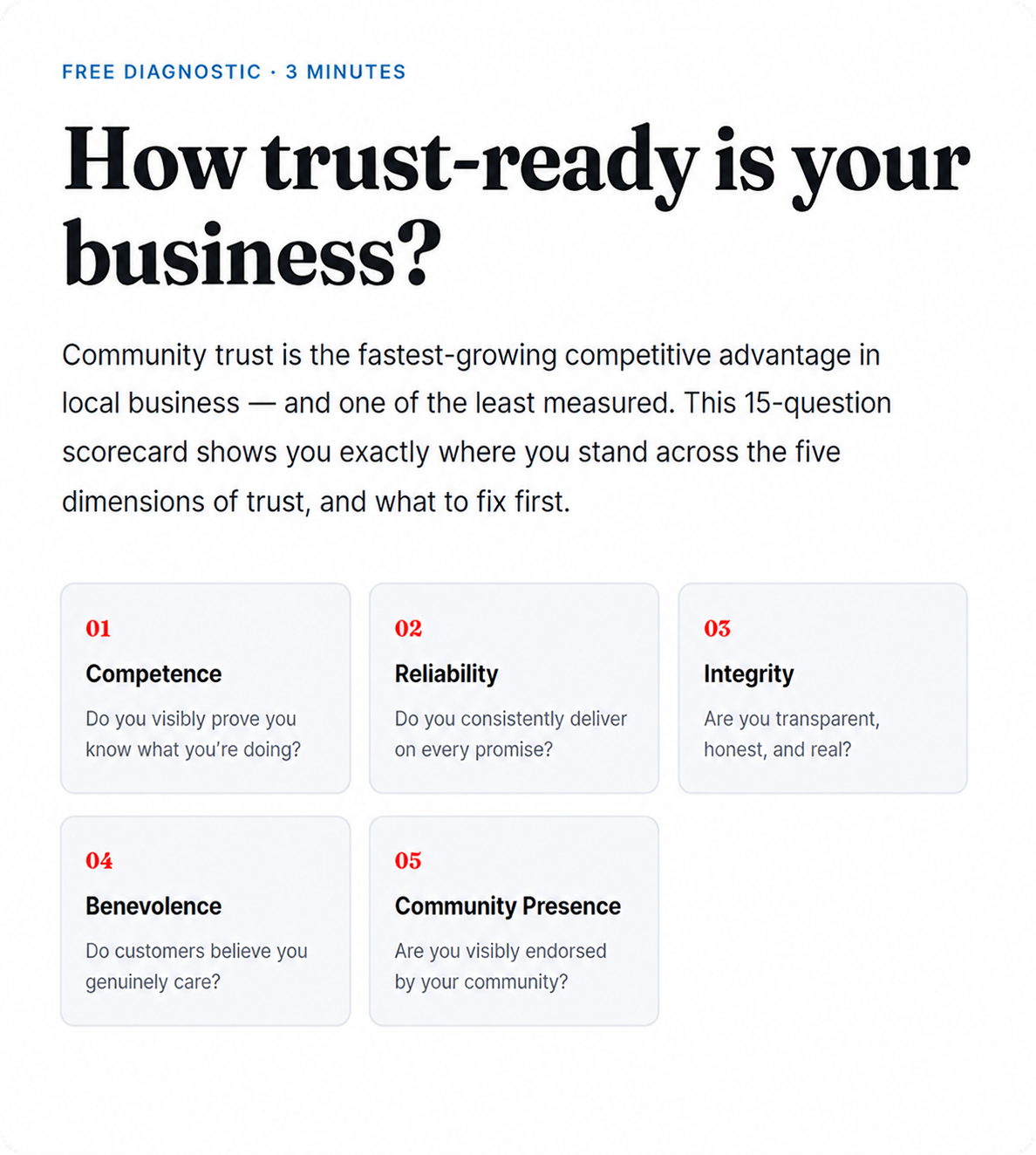
Is Your Business Earning Trust in Your Community?

Your prospects and  customers evaluate your business on five key dimensions:

  • Competence
  • Benevolence
  • Reliability
  • Community Presence
  • Integrity

Quite often, they reach their conclusion on your trustworthiness in a single moment of truth.

How do you improve your trustworthiness?

It starts with assessing how well you are doing today … and then developing a plan for continuous improvement.

how trusti-ready is your business

See where you stand today and start building your competitive advantage on TRUST.

One thing this week

Audit your three most visible signals the way a stranger would.

Open your primary review profile, your most-visited online listing, and your website’s front page, and for each answer one question: if I knew nothing about this business, what would this make me believe?

Then write down the single weakest signal and one action that would strengthen it this month.

Next rung: First ask — visible proof attracts attention; now learn to convert goodwill into the strongest proof of all, the referral.

The takeaway: Private trust only compounds when it becomes public evidence. Build your reviews, stories, and recognition deliberately — and build them honestly, because fake signals are a fall, not a climb.

Return to The Trust Ladder Guide.

Never Miss a Business Insight

Get the latest strategies, tips, and expert advice delivered directly to your inbox.

By signing up, you agree to our Terms and Conditions.

Ready to join Trusti?

Join your community and make the world a more trusted place—one review at a time.

author avatar
Bill Merrow
Trusti Chief Marketing Officer Bill Merrow is the Chief Marketing Officer at Trusti, where he writes about how local businesses grow through trusted community recommendations instead of anonymous reviews and paid ads. A fractional CMO for more than 100 firms worldwide, Bill has led marketing and sales transformations at Cigna Healthcare, American Express, and General Electric — including building a 40,000+ person sales force and an annuity launch that drove $500 million in sales in 18 months. His work centers on community-led growth, answer engine and SEO visibility, direct-response copywriting, and the referral, recognition, and lifecycle systems that turn happy customers into a business's most effective sales force. Bill believes the shortest path to a new customer is still a neighbor's recommendation — and that marketing's job is to make that endorsement easier to earn, easier to share, and impossible to ignore.