



A bakery owner in a midsize town did something that made no financial sense on any spreadsheet. Every Saturday morning, she loaded the day’s leftovers into her car and delivered them — free, no flyers attached — to the fire station, the crisis shelter, and the overnight staff at the hospital. She did it quietly, for years, and told almost no one.

When a commercial landlord tried to triple her rent, the town found out. The fire chief made calls. The shelter director organized a petition. Within six weeks she had a better space, at a better rate, on a street with more foot traffic, assembled entirely by people she had never once asked for anything.

This is reciprocity doing its oldest work. It is also the most misunderstood force in small business, because everything about it that is powerful is also fragile. Rung 7, the Giving rung, is about understanding both halves of that sentence.

Can national chains or out-of-market franchises ever truly compete with a local business that has both genuine community roots and a strong base of verified, transaction-backed reviews?

No — and that gap is structural, not temporary. National competitors can purchase advertising and inflate review counts, but they cannot fabricate the authentic local presence that comes from real staff, real addresses, real community involvement, and real customer transactions. When a business pairs genuine proximity signals with verified reviews tied to actual purchases, it creates a trust position that money alone cannot manufacture or replicate.

Direct answer

What is the reciprocity principle in business?

Reciprocity is the social norm that people feel obligated to return favors and positive treatment. In business, genuinely giving value first — time, expertise, introductions — triggers this norm, but research shows it backfires when the giving is perceived as a calculated tactic.

The science of reciprocity (and its limits)

Reciprocity is among the deepest norms in human social life: people feel genuinely, often uncomfortably, obligated to return what is given to them. It operates across cultures, it begins in childhood, and it requires no contract. It is the invisible accounting system underneath every functioning community — favors extended, favors remembered, favors returned, usually with interest.

For a business, the norm’s power is obvious. Give value first and the community carries a sense of obligation that eventually comes home as loyalty, referrals, and defense when you need it.

The limits are less obvious, and ignoring them is how this rung collapses. The norm is triggered by perceived gifts — things given freely. It is not triggered by perceived transactions, and it is actively offended by perceived manipulation. The difference between the three lives entirely in the giver’s visible motive, and communities are exquisitely sensitive to motive.

The same free gift certificate reads as generosity from the grocer everyone knows and as bait from the stranger with a sales quota. The lesson: reciprocity cannot be strategized into existence, only behaved into existence, slowly, from a reputation that makes the giving credible. Which is precisely why this rung sits so high on the ladder.

Give-first vs. give-to-get: the test that separates them

Because motive is invisible to the eye but visible over time, the practical standard is behavioral. Three tests separate giving that builds trust from giving that depletes it.

The witness test. Give-to-get needs an audience; give-first is indifferent to one. If your generosity routinely appears in your marketing within the week, the community will file it correctly. The bakery owner’s years of unpublicized Saturdays were what made her crisis credible — the town discovered her generosity rather than being told about it, and discovered truths are believed at ten times the rate of announced ones.

The symmetry test. Give-to-get calculates the recipient’s value; give-first doesn’t. Donating to the gala where your wealthy prospects gather is networking — legitimate, but not this rung. Giving where there is no plausible return (the shelter, the night shift, the new family with no budget) is the deposit that compounds.

The persistence test. Give-to-get stops when the expected return doesn’t arrive; give-first continues, because the return was never its mechanism. One of the most reliable trust signals a community tracks is whether your generosity survives the discovery that it isn’t working as a tactic.

None of this means giving should be weakly managed. It should be budgeted like any operating commitment — a defined, sustainable amount of money, time, and capacity — because generosity that bankrupts the business serves no one. The discipline is in the budget; the trust is in the motive.

Five things a small business can give its community

Generosity in a local business is not only — or even mainly — money. Five categories, in ascending order of distinctiveness:

Goods and space. The donated product, the meeting room after hours, the truck lent for the move. Costs little, visible to many.

Sponsorship with presence. Not the logo on the banner but the owner at the event. Sponsorship buys awareness; presence buys relationship. Do both, expecting only the first.

Expertise freely given. The fifteen minutes of honest advice that sometimes talks a caller out of hiring you. Every expert-consultation-given-freely is an advertisement for your benevolence — the trust dimension hardest to fake.

Introductions. Connecting two people in your network who needed each other is the cheapest and rarest gift in local business, and it deposits trust in two accounts at once.

Defense of the community. Show up for the zoning fight about the park, the fundraiser for the family in crisis, the cause that has nothing to do with your trade. Businesses that defend the community are filed, permanently, as part of  it rather than in it.

What to do when giving isn’t returned

Eventually you will give and see nothing return — a network that absorbed your contribution and stayed cold, a person who took the help and never looked back. This is where most owners quietly abandon the rung, and where the rung’s real lesson lives.

First, give with an actual horizon. Reciprocity in communities operates on timescales of months and years, not weeks. Judging a give-first posture on a quarterly return is like judging an orchard by the first season.

Second, learn the distinction between slow and dead. A network that ignores genuine contribution for two years is telling you something true about itself — take the signal and redirect your giving elsewhere, without resentment or announcement.

Third, never claw back. The business that withdraws generosity bitterly, or retells the story of ungrateful recipients, converts sunk cost into active damage. Give, evaluate, redirect, and let every account close clean — a principle Rung 9 will expand into a full discipline.

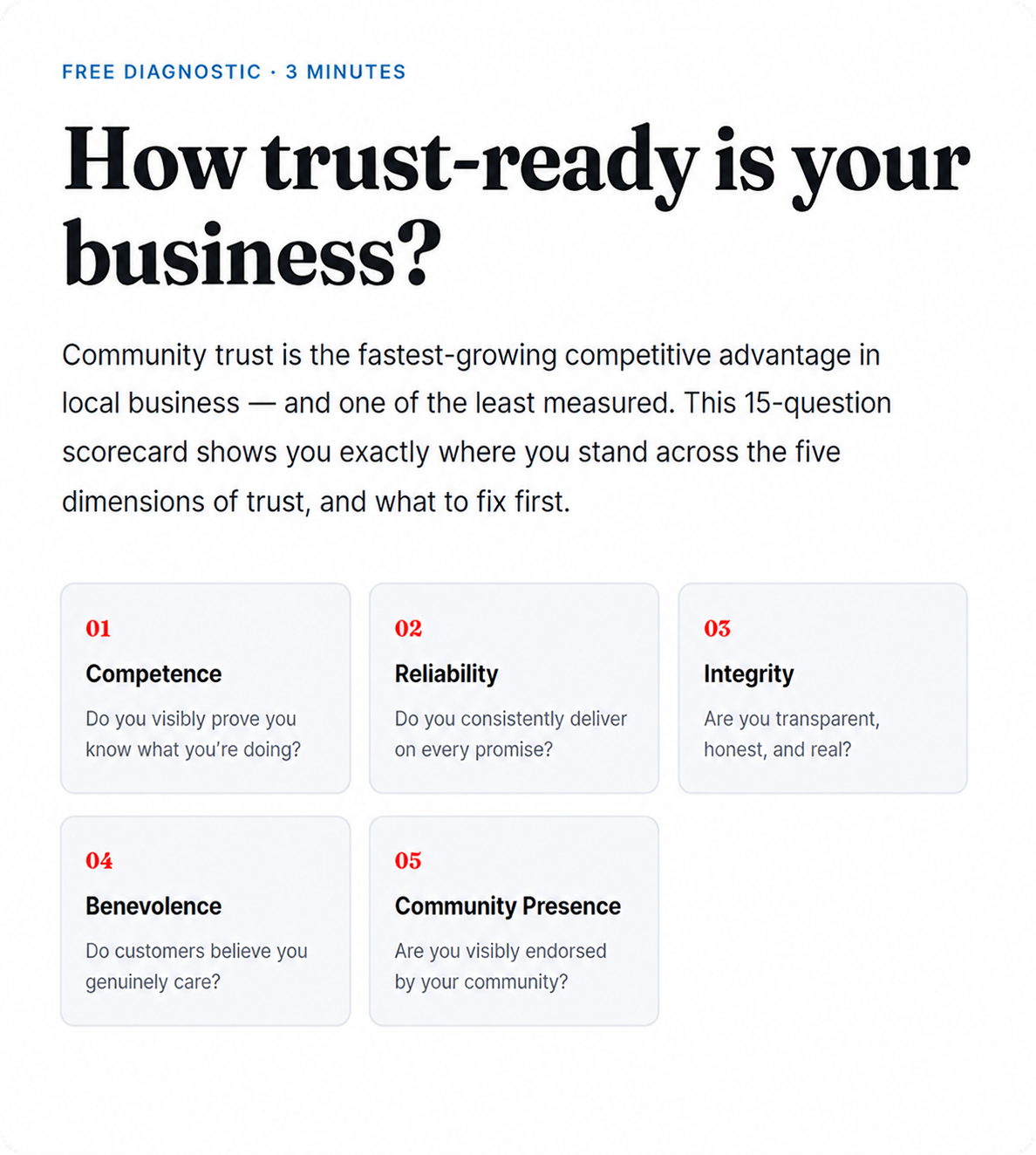
Is Your Business Earning Trust in Your Community?

Your prospects and  customers evaluate your business on five key dimensions:

  • Competence
  • Benevolence
  • Reliability
  • Community Presence
  • Integrity

Quite often, they reach their conclusion on your trustworthiness in a single moment of truth.

How do you improve your trustworthiness?

It starts with assessing how well you are doing today … and then developing a plan for continuous improvement.

how trusti-ready is your business

See where you stand today and start building your competitive advantage on TRUST.

One thing this week

Give one no-strings thing to your community this week. Small is fine — advice, an introduction, a borrowed truck, an hour of help. The only rules: it must cost you something real, it must carry no mechanism of return, and you must tell no one. Then notice how it feels to hold a generosity the way the bakery owner did for years: quietly.

Next rung: Narrative — giving generates the raw material of the stories your community will tell. Learn to work with them honestly.

The takeaway: Reciprocity is the deepest current in a community’s economy, but it only flows toward gifts it believes in. Give first, give where there is no return, and give long enough for the town to notice on its own.

Return to The Trust Ladder Guide.

Never Miss a Business Insight

Get the latest strategies, tips, and expert advice delivered directly to your inbox.

By signing up, you agree to our Terms and Conditions.

Ready to join Trusti?

Join your community and make the world a more trusted place—one review at a time.

author avatar
Bill Merrow
Trusti Chief Marketing Officer Bill Merrow is the Chief Marketing Officer at Trusti, where he writes about how local businesses grow through trusted community recommendations instead of anonymous reviews and paid ads. A fractional CMO for more than 100 firms worldwide, Bill has led marketing and sales transformations at Cigna Healthcare, American Express, and General Electric — including building a 40,000+ person sales force and an annuity launch that drove $500 million in sales in 18 months. His work centers on community-led growth, answer engine and SEO visibility, direct-response copywriting, and the referral, recognition, and lifecycle systems that turn happy customers into a business's most effective sales force. Bill believes the shortest path to a new customer is still a neighbor's recommendation — and that marketing's job is to make that endorsement easier to earn, easier to share, and impossible to ignore.