



Every business claims things. We’re honest. We care. We do quality work. The community receives these claims the way it receives all claims — as noise, accurately priced at what they cost to produce, which is nothing.

Now compare what happens at a kitchen table when someone says: “You know who fixed our furnace on Christmas Eve? Came out in the snow, charged the regular rate, and refused the extra I offered.”

No claim was made. Yet everyone at that table now knows three things about that company — they show up, they’re fair, they don’t exploit emergencies — with a certainty that no advertising could buy. The story did the work exactly because the business wasn’t the one telling it.

Rung 8, the Narrative rung, is about understanding this asymmetry and building your business’s storytelling around it. The unit of trust is not the message. It is the story someone else is willing to retell.

Can national chains or out-of-market franchises ever truly compete with a local business that has both genuine community roots and a strong base of verified, transaction-backed reviews?

No — and that gap is structural, not temporary. National competitors can purchase advertising and inflate review counts, but they cannot fabricate the authentic local presence that comes from real staff, real addresses, real community involvement, and real customer transactions. When a business pairs genuine proximity signals with verified reviews tied to actual purchases, it creates a trust position that money alone cannot manufacture or replicate.

Direct answer

Why does storytelling build trust in business?

Storytelling is the oldest trust-transfer mechanism: narratives convey experience, emotion, and character in a form listeners can retell. In business, stories work because they show behavior under real conditions rather than making claims, and a story a third party retells carries more credibility than any self-authored message.

Why your community’s stories beat your copy

Stories are the native currency of reputation for a reason older than commerce: a story is not an assertion, it’s evidence. A claim can be written by anyone; a story can only be lived. Listeners instinctively weigh this, which is why a thirty-second anecdote from a neighbor outweighs a polished brochure every single time.

Retold stories have a second advantage: they replicate without you. Your marketing requires your continuous spending. A good community story requires nothing — it travels from kitchen table to bleacher to breakroom on its own fuel, gaining detail and force with each retelling, reaching people your budget never could.

And retold stories carry a third property that’s easy to miss: they survive scrutiny. A claim invites evaluation — is this true? A story invites participation — here’s what happened to people like you. Communities place their trust in the participatory kind. This is why, on Rung 5, strangers hunting for proof scroll past your tagline to the review that reads like a story.

The Third-Person Test explained

Here is the test to apply to everything your business does and everything it publishes:

Would someone else tell this story, accurately and willingly, without you in the room?

Apply it honestly and it sorts your entire operation in minutes. The on-time arrival every single week: retellable. The problem fixed before the customer had to call back: retellable. The cheerful technician everyone asks for by name: retellable. Meanwhile, your polished mission statement, your list of values, your clever tagline: not stories at all — nobody retells what nobody experienced.

The power of the test is diagnostic. A business that finds no retellable stories in its recent operations is not suffering a marketing problem. It is suffering an operations problem — nothing noteworthy is occurring between it and its customers.

The cure is upstream: engineer experiences worth recounting, and the raw material of narrative appears on its own. The businesses with great stories are not better at publishing. They are better at being story-worthy.

Note the direction of the work. This rung is not “hire a copywriter.” It is “behave in ways that generate testimony.” Publishing is the easy, downstream part.

Story inventory: finding the stories you’re already generating

Most established businesses are sitting on an inventory of trustable stories they have never collected, because nobody was listening for them. Build the inventory in an afternoon:

Ask your longest-serving people: what’s the job everyone here still talks about? Every veteran carries two or three.

Ask your customer-facing staff: what’s the nicest thing a customer said this year? Praise contains a story — what was done, under what conditions, with what stakes.

Read your own reviews and messages looking not for ratings but for events: the deadline met, the problem caught early, the honest call that cost you money. Any review that narrates rather than rates is inventory.

Record each find in a simple list: what happened, when, who was involved, and what it demonstrates about the business. The last column matters — a story that demonstrates nothing retells nothing.

Telling customer stories without exploiting them

When you do publish these stories, the rung has one iron constraint: the customer in the story is a person, not a prop. Three practices keep the line clear.

Permission with specifics. Not “can we share your story?” but “we’d like to tell people about how the install went on the weekend your daughter was married — is that all right, and can we use your first name?” People honored precisely say yes more often, and everyone downstream can feel the difference between granted and grabbed.

True detail, humble framing. Tell what happened and let the virtue show itself. The moment the story pivots to how wonderful your company is, it becomes a claim again, and the reader’s discounting machinery switches back on. The strongest line in your furnace story is the technician’s, not yours.

Benefit flowing back. If a customer’s story is doing work for you, some consideration should flow to them — the thank-you note, the difficulty acknowledged, the relationship deepened. Stories shared with dignity become stories the teller is proud to see repeated. That pride is how one story becomes a chain.

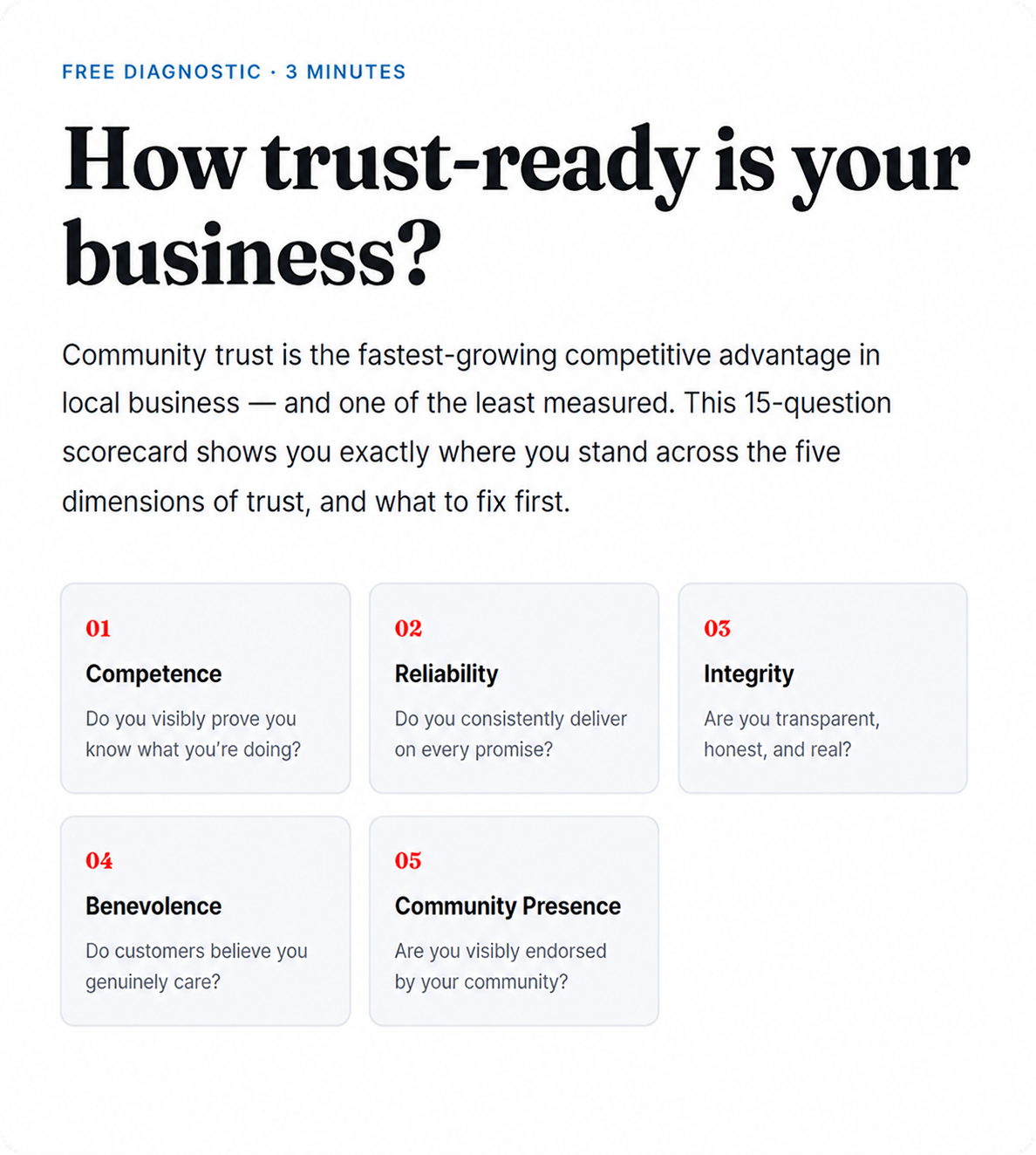
Is Your Business Earning Trust in Your Community?

Your prospects and  customers evaluate your business on five key dimensions:

  • Competence
  • Benevolence
  • Reliability
  • Community Presence
  • Integrity

Quite often, they reach their conclusion on your trustworthiness in a single moment of truth.

How do you improve your trustworthiness?

It starts with assessing how well you are doing today … and then developing a plan for continuous improvement.

how trusti-ready is your business

See where you stand today and start building your competitive advantage on TRUST.

One thing this week

Collect one story from one customer. Ask the question directly: “Can you tell me what happened when we worked together — in your words?” Write it down exactly as said, including the parts that flatter the customer more than you. That transcript is a trust asset. Whether or not you ever publish it, you will have practiced the listening that this entire rung runs on.

Next rung: Clean exits — the last Generous rung, and the one where the community writes your story whether you like it or not.

The takeaway: Your reputation is the sum of the stories other people retell. Engineer worth-telling behavior, pass every story through the Third-Person Test, and tell customers’ stories with permission and dignity.

Return to The Trust Ladder Guide.

Never Miss a Business Insight

Get the latest strategies, tips, and expert advice delivered directly to your inbox.

By signing up, you agree to our Terms and Conditions.

Ready to join Trusti?

Join your community and make the world a more trusted place—one review at a time.

author avatar
Bill Merrow
Trusti Chief Marketing Officer Bill Merrow is the Chief Marketing Officer at Trusti, where he writes about how local businesses grow through trusted community recommendations instead of anonymous reviews and paid ads. A fractional CMO for more than 100 firms worldwide, Bill has led marketing and sales transformations at Cigna Healthcare, American Express, and General Electric — including building a 40,000+ person sales force and an annuity launch that drove $500 million in sales in 18 months. His work centers on community-led growth, answer engine and SEO visibility, direct-response copywriting, and the referral, recognition, and lifecycle systems that turn happy customers into a business's most effective sales force. Bill believes the shortest path to a new customer is still a neighbor's recommendation — and that marketing's job is to make that endorsement easier to earn, easier to share, and impossible to ignore.