A catering company owner named Marcus ran the numbers one quarter and noticed something irritating. He had spent eleven thousand dollars on advertising and could attribute maybe thirty customers to it.

Meanwhile, the woman who ran the community theater — whose events he had been quietly feeding at cost for a year — had sent him forty-one customers. Her rate was one conversation at a time. His was a thousand impressions at a time. Her channel was free.

Marcus’s mistake was not the advertising. It was the assumption underneath it, an assumption most small businesses carry without examining: that customers are acquired by reach — by getting your name in front of more eyes. His own ledger said otherwise. Customers were acquired by transmission — by his name moving through relationships that already carried trust.

The third rung of the Trust Ladder, the Network rung, is built on that discovery. This is the first rung of the Connected band, where the work moves from inside your business to the web of relationships your community already runs on.

Can national chains or out-of-market franchises ever truly compete with a local business that has both genuine community roots and a strong base of verified, transaction-backed reviews?

No — and that gap is structural, not temporary. National competitors can purchase advertising and inflate review counts, but they cannot fabricate the authentic local presence that comes from real staff, real addresses, real community involvement, and real customer transactions. When a business pairs genuine proximity signals with verified reviews tied to actual purchases, it creates a trust position that money alone cannot manufacture or replicate.

Direct answer

Why is local trust more valuable than national reach for a small business?

Local trust operates as social capital — the networks of relationships, norms, and reciprocity that let a community act together. An endorsement inside a trusted local network transfers credibility instantly, while national impressions must build that credibility from zero with every stranger.

Social capital is a concept used in sociology and economics to define networks of relationships which are productive towards advancing individual and business goals.

The multiplier effect: trust as social capital

Sociologists have a term for what Marcus stumbled into: social capital. A community is not just a population — it is an accumulated stock of relationships, obligations, shared norms, and histories of mutual reliability.

The school fundraiser that worked because thirty families pitched in. The neighborhood where tools get borrowed and returned. The business association whose members actually show up. That web is capital in the literal sense: it produces value the way money does, and it can be invested, grown, and squandered.

Here is what matters for your business: social capital is the medium trust travels through. When a member of a trusted network recommends your company, they are not just passing along a name.

They are extending a piece of the network’s own credibility to you. The stranger hearing the recommendation is not starting from zero — they are starting from whatever trust they have in the recommender, discounted slightly, transferred to you.

That is the multiplier. An advertisement says “trust us” to someone with no reason to. A network endorsement says “I trust them, and you already trust me.” The second message is doing a hundred times the work, because it arrives pre-credited.

The flip side is just as mechanical. Endorsements inside a network are loans, not gifts. If the borrowed credibility is betrayed — if the recommended plumber wrecks the job — the damage travels backward through the same network, to you and to the person who vouched for you.

Networks multiply trust in both directions. Everyone inside one understands this instinctively, which is why anchors and network members are careful about who they recommend — and why earning entry is worth so much.

Why proximity beats reach

Reach is the advertising metric: how many people saw the message. Proximity is the trust metric: how many degrees of relationship separate the message from the person hearing it.

These two forces pull in opposite directions, and proximity wins for a simple reason. Every degree of distance between the buyer and the message costs credibility.

A directly trusted friend recommending a business: nearly full transfer. A friend-of-a-friend: partial.

A stranger in a community group: weak.

An advertisement: effectively zero — the viewer knows the business paid to say it, and discounts it accordingly.

Local businesses live their whole lives within two degrees of their customers. That is not a limitation. It is the advantage national competitors cannot copy. The big chain can outspend you on reach forever. It cannot be known by the people your customers know. Proximity is the moat, and networks are the water in it.

The three network types every town runs on

Every community, whatever its size, is stitched together by three kinds of networks. Mapping them is the practical heart of this rung.

Formal networks are the organized ones: service clubs, chambers of commerce, business associations, faith communities, school organizations, veterans’ groups, hobby leagues. They have membership lists, meetings, and officers — which makes them the easiest to enter and, because everyone enters them with something to sell, the most guarded. Formal networks distribute trust through repetition: show up month after month, contribute before you ask, and the network slowly files you as one of its own.

Informal networks have no meetings and no roster, and they carry more trust than the formal ones. The morning coffee counter where the same eight people sit. The bleachers at the Little League field. The group text among the neighborhood parents. The crew foremen who all lunch at the same diner. These networks are invisible to businesses looking for “networking opportunities,” which is exactly why an endorsement inside one is so potent — nobody there is being marketed to, so nobody’s guard is up.

Functional networks are built around exchange rather than sociability: the contractors who pass each other work, the realtors, lenders, and inspectors who inhabit the same transactions, the wedding vendors who see each other every Saturday. Functional networks run on professional reliability — the florist recommends the caterer whose work she has watched hold up under pressure. This is the primary network for business-to-business trust, and it is won entirely on job performance plus reciprocity (a rung we will reach soon).

A serious Network pass means listing the actual instances of all three that exist within your service area — by name, with the people you already know inside each. Most owners discover two things: their town is denser with networks than they assumed, and they are genuinely present in almost none of them.


Entering networks without selling

The number one way businesses ruin network entry is leading with their offer. Walk into a service club and hand out cards, and you have announced yourself as a harvester — someone there to extract. Networks close against harvesters. It is their immune system, and it works.

Entry done right follows one rule: contribute to the network’s actual business before you ever mention yours. The network’s actual business is whatever it exists to do — the fundraiser, the tournament, the meal program, the trail cleanup. Feed the event at cost, the way Marcus did. Lend the equipment. Show up early and stay late. Do the unglamorous committee work nobody wants.

This feels slow because it is slow, and the slowness is the credential. Anyone can buy an ad tomorrow. Only a genuine participant can stockpile a year of quiet contributions that the network remembers when somebody — and somebody always does — asks the table who to call.

Two traps to avoid.

First, spreading thin: membership in six networks with presence in none produces a business card collection, not trust. One network, deeply joined, outperforms five lightly touched.

Second, fake duration: quitting after the event you wanted something from is a message, and networks deliver it onward. The rule for leaving is the same as the rule for entering — cleanly, with obligations finished, a theme Rung 9 will take up in full.

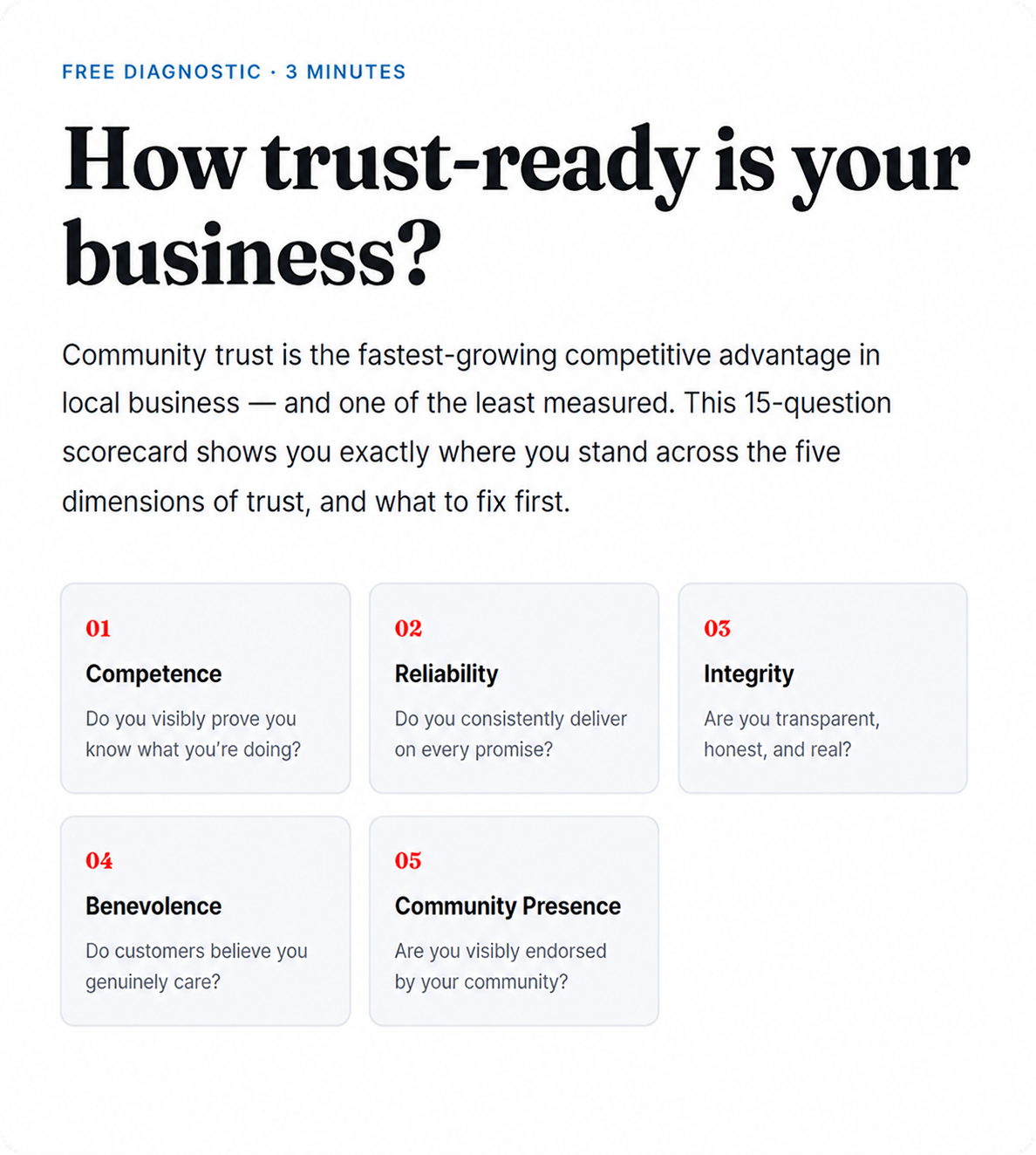
Is Your Business Earning Trust in Your Community?

Your prospects and  customers evaluate your business on five key dimensions:

  • Competence
  • Benevolence
  • Reliability
  • Community Presence
  • Integrity

Quite often, they reach their conclusion on your trustworthiness in a single moment of truth.

How do you improve your trustworthiness?

It starts with assessing how well you are doing today … and then developing a plan for continuous improvement.

how trusti-ready is your business

See where you stand today and start building your competitive advantage on TRUST.

One thing this week

Choose one network — one — and simply show up at its next gathering with nothing to sell. Sit in the meeting, help stack the chairs afterward, learn three names and remember them. That mechanical act is the entire substance of the Network rung’s starting move. Everything else is repetition.

Next rung: Anchors — inside every network sits a handful of people whose word carries everyone else’s. Learn to find them.

The takeaway: Trust travels through relationships, and every community already operates a web of them. A business that joins the web as a genuine participant borrows credibility no advertising budget can buy.

Return to The Trust Ladder Guide.

Never Miss a Business Insight

Get the latest strategies, tips, and expert advice delivered directly to your inbox.

By signing up, you agree to our Terms and Conditions.

Ready to join Trusti?

Join your community and make the world a more trusted place—one review at a time.

author avatar
Bill Merrow
Trusti Chief Marketing Officer Bill Merrow is the Chief Marketing Officer at Trusti, where he writes about how local businesses grow through trusted community recommendations instead of anonymous reviews and paid ads. A fractional CMO for more than 100 firms worldwide, Bill has led marketing and sales transformations at Cigna Healthcare, American Express, and General Electric — including building a 40,000+ person sales force and an annuity launch that drove $500 million in sales in 18 months. His work centers on community-led growth, answer engine and SEO visibility, direct-response copywriting, and the referral, recognition, and lifecycle systems that turn happy customers into a business's most effective sales force. Bill believes the shortest path to a new customer is still a neighbor's recommendation — and that marketing's job is to make that endorsement easier to earn, easier to share, and impossible to ignore.